Latest Johnny Cash
News
Even though this two-CD package won't be in stores until May 23, I think many Johnny Cash fans would enjoy a preview of the latest in his long line of releases.
Johnny Cash: Personal File is a collection of 49 previously unreleased tracks that had been stored on tapes marked "Personal File" in the House of Cash in Hendersonville. They were all tracks he recorded with just his acoustic guitar and his voice and then stored away in a private room where he kept such personal treasures as his Jimmie Rodgers memorabilia. Apparently at the time he recorded them, he thought no one would be interested in such a stripped-down sound. When he later cut his first CD for the American Recordings label with producer Rick Rubin (1994's American Recordings), he remarked that he had made a similar record in the 1970s but could interest no labels in it. Those songs are here, in addition to some he recorded later.
The song selection reflects Cash's far-ranging interest in all kinds of music. There are poems, old Carter Family songs, 19th century ballads, Irish songs, as well as original Cash material. Cash covers such country hits as Lefty Frizzell's "Saginaw, Michigan" and Johnny Horton's "When It's Springtime in Alaska (It's Forty Below)," as well as the Cash-Horton collaboration, "Girl in Saskatoon."
Cash tells a charming story about the children's song "Tiger Whitehead," which Cash co-wrote with his friend Dr. Nat Winston. The song resulted from Dr. Winston taking Cash to see the 19th century gravesites of the famed bear hunter and his wife Sally in Whitehead, Tenn. Tiger's tombstone noted that he killed 99 bears. His wife's burial marker notes that she nursed two bear cubs that Tiger had brought home. Cash later recorded it on a children's album.
There are songs by such contemporary writers as his then-son-in-law Rodney Crowell, his stepdaughter Carlene Carter, Kris Kristofferson and John Prine. And there are spoken introductions to many of the songs.
This is a treasure chest of vintage acoustic Cash. A cache of 49 songs is a lot to absorb all at once, so I've sifted through the songs over several days and found much to savor. Cash began recording these in July 1973 and cut 24 songs then. The other sessions came three months later in 1973 and in 1974, 1976, 1977, 1980 and 1982. The bulk of the recordings are from 1973, which astonishingly was a very prolific records release year for Cash, in which Columbia Records released four Cash albums, followed by three more in 1974. None of them sold especially well, and only 1973's Any Old Wind That Blows broke the Billboard Top 10.
The first 1973 sessions are obviously songs that 1973-era Nashville record labels would never release, and you have to wonder if these songs amounted to pressure valves that Johnny Cash, the artist, wanted to cut versus songs Johnny Cash, the hit machine, couldn't record. These were mostly covers, and some were very sentimental songs such as "There's a Mother Always Waiting at Home," "Missouri Waltz" and the Louvin Brothers' "When I Stop Dreaming." He also did a five and a-half-minute version of the epic poem, "The Cremation of Sam McGee," which I memorized in college and which was a staple of Texas bars and I'm sure of bars everywhere late at night. I think Cash fans will be delighted to hear his lively rendition of this classic Robert W. Service poem.
Personal File Track Listing
Johnny Cash Personal File is scheduled for release in May 2006 and will feature the following tracks:
Disc One:
The Letter Edged In Black
There’s A Mother Always Waiting At Home
The Engineer’s Dying Child
My Mother Was A Lady
The Winding Stream
Far Away Places
Galway Bay
When I Stop Dreaming
Drink To Me Only With Thine Eyes
I’ll Take You Home Again Kathleen
Missouri Waltz
Louisiana Man
Paradise
I Don’t Believe You Wanted To Leave
Jim I Wore A Tie Today
Saginaw, Michigan
When It’s Springtime In Alaska (It’s Forty Below)
Girl In Saskatoon
The Cremation Of Sam McGee
Tiger Whitehead
It’s All Over
A Fast Song
Virgie
I Wanted So
It Takes One To Know Me
|
Disc Two:
Seal It In My Heart And Mind
Wildwood In The Pines
Who At My Door Is Standing
Have Thine Own Way Lord
Lights Of Magdala
If Jesus Ever Loved A Woman
The Lily Of The Valley
Have A Drink Of Water
The Way Worn Traveler
Look Unto The East
Matthew 24 (Is Knocking At The Door)
The House Is Falling Down
One Of These Days I’m Gonna Sit Down And Talk To Paul
What On Earth (Will You Do For Heaven’s Sake)
My Children Walk In Truth
No Earthly Good
Sanctified
Lord, Lord, Lord
What Is Man
Over The Next Hill (We’ll Be Home)
A Half A Mile A Day
Farther Along
Life’s Railway To Heaven
In The Sweet Bye And Bye
|
Sunday
March 5, 2006
A double disc of Johnny
Cash's home-recorded music will be released in May by Sony BMG's Legacy
Recordings. Personal File features music Cash recorded in his House of
Cash studio near Nashville in the early 1970s through the early 1980s. It
includes original songs, covers, poetry and stories about his teenage
years. None of the 49 performances on Personal File has ever been
released. In addition, Live in Denmark, a Cash concert from the 1970s, is
scheduled for DVD release in June.
Fri. January 20.2006 6:10 PM EST
Cash and Underwood Still On Top of Charts
Man in Black Claims Five of Top Spots on Catalog Sales List
With Carrie Underwood continuing to top Billboard's chart of current country albums, Johnny Cash claims five of the Top 7 positions on the trade publication's list of older albums. His sales could experience another spike next week after Walk the Line, the film about his life, resulted in three wins earlier this week at the Golden Globe awards.
Topping Billboard's Top Country Catalog Albums chart is Cash's 16 Biggest Hits, a CD released more than six years ago. The catalog albums chart reflects reissues and older albums that have fallen below No. 100 on the all-genre Billboard 200 chart.
In second place on the catalog chart is Tim McGraw's Greatest Hits and Keith Urban's Golden Road. But in fourth through seventh place, respectively, are four more Cash titles -- The Essential Johnny Cash, Johnny Cash at Folsom Prison, American IV: The Man Comes Around and Super Hits.
August 25, 2004
Wed 25 August, 2004 01:47 AM
NASHVILLE, Tennessee (Reuters) - Out of a
small cabin hideaway near country music icon Johnny Cash's huge lakeside
estate, vacant since he and his wife died last year, has come a rare album
by big-name singers and musicians produced by Cash's son, John Carter
Cash.
Lavishly adorned with backwoods,
Appalachian-rooted songs delivered in various styles, "The Unbroken
Circle -- the Musical Heritage of the Carter Family," pays tribute to
the original Carter family trio that disbanded in 1941.
The trio's legacy -- including the first
commercially successful country recordings that were hits in the 1920s --
has been renewed on the new album that features current artists'
renditions of their classics.
Johnny Cash's marriage in 1968 to June Carter
-- whose mother Maybelle was in the original trio with A.P. and Sarah
Carter -- united extraordinary family talents that are apparent in this
tribute album, released on August 24 on the Dualtone label.
Tracks include Emmylou Harris and the Peasall
Sisters with "On the Sea of Galilee," George Jones with
"Worried Man Blues," Sheryl Crow with "No Depression in
Heaven" and Rosanne Cash with "The Winding Stream" and
others.
Johnny Cash appears on the 15-track album
singing "Engine One-Forty-Three," and June Carter Cash with
"Hold Fast to the Right."
At age 33, soft-spoken John Carter Cash, now
taller than his famous father but bearing no facial resemblance, works
almost daily at the Cash Studio Cabin. The younger Cash plunged into
learning the art of making music while his father was still alive and
using the cabin for many of his recordings.
The studio became even more important after
Johnny Cash was dropped in 1986 by CBS Records at age 54 because of
declining sales, despite a 28-year career making dozens of hits and
touring world wide and becoming a household name.
Cash responded to the snub by Nashville's
music businessmen by linking up with Los Angeles producer Rick Rubin, a
well-known producer of rap, rock and heavy metal bands. The result was a
string of awards for Cash including Grammys in 1994 and 1997.
CABIN'S RUTTED ROAD
John Carter Cash shows off an updated control
room and echo chamber where many of the musicians recorded their
contributions to "The Unbroken Circle" after braving the rocky,
rutted road leading to the otherwise simple wood cabin that houses the
studio.
Like his father, he believes in artistic
license, allowing the musicians to "give it their own
interpretation," he said, as an antidote for producers who use a
heavy, controlling hand.
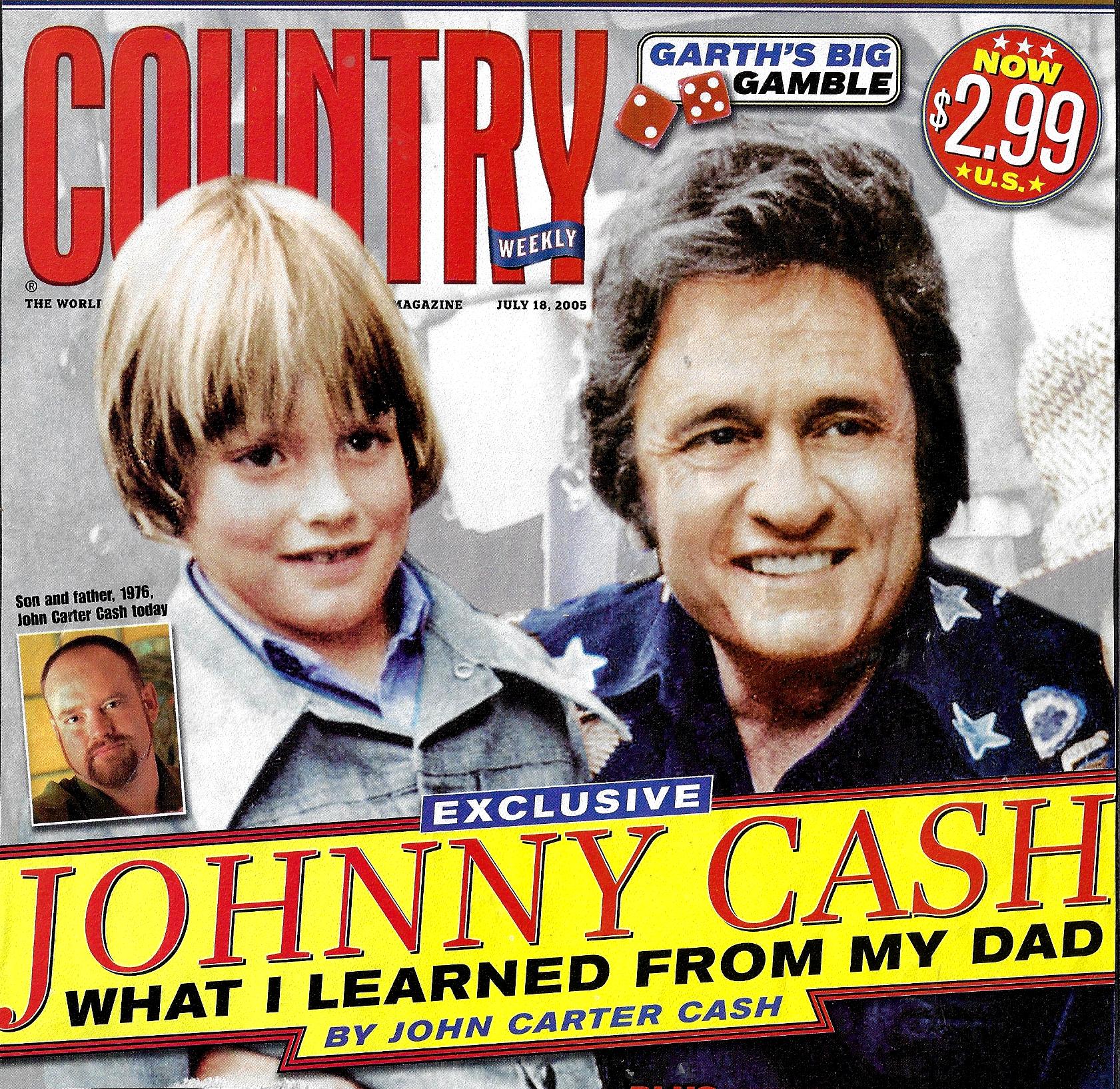
"My parents taught me some great
lessons," he says. "I also learned that you have to continue to
develop and move forward even though it isn't always easy."
Still wounded by the deaths of his parents
within months of each other in 2003, John Carter is bearing the
responsibility of helping to arrange an auction of their estate. Around
780 lots of Cash memorabilia worth thousands of dollars will be offered by
Sotheby's in New York from September 14 to 16, including awards, guitars,
gold records and stage clothing.
"My parents decided on this auction to
avoid the problems that the deaths of other celebrities had caused among
their heirs," he says. "We haven't put up everything for sale.
This represents only a third of the estate but we need the proceeds to pay
the estate tax. And there is really an over-abundance of
possessions."
His father bought the large stone and wood
beam home on a 170 acre (69 hectares) spread in a Nashville suburb in
1967. It is also for sale.
"Before they died, my parents gave to
each of us children special items that had been meaningful to us
individually," John Carter says of gifts to his parents' offspring
from previous marriages.
Still, selecting the items to be auctioned
wasn't easy. Included are seven of his father's thirteen Grammys, his 1996
Kennedy Centre Lifetime Achievement Award, a 1981 Rolls Royce Silver Spur
automobile, handwritten lyrics and letters, photos, concert posters and
original Carter family memorabilia.
Leafing through the lavish Sotheby's
catalogue, John Carter pauses at a photo of custom-made, knee-high
alligator boots Johnny Cash wore during his CBS television shows.
"His favourite boots," he muses.
"I remember watching as he used to scuff the soles with a pocketknife
so he wouldn't slip on stage."
There's also a cherished note that tells of
Johnny passing valuable recording skills to John while working together: a
1999 letter to producer Rubin suggesting another recording session at the
cabin, noting that he and his son had produced a "fine gospel
album."
By Pat Harris

August 9, 2004
By Len Righi
Roseanne Cash salutes father, delights fans at Musikfest
She plays hits and even takes requests. 'Pancho & Lefty' is a surprise.
Rosanne Cash's performance Saturday night at Musikfest was as exquisite as the finest cut crystal.
The sensitive, tasteful guitar backing supplied by her husband-producer, John Levanthal, as well as Foy Hall's acoustics and even the two decorative candelabras at the rear of the stage, further enhanced an emotionally rich experience.
A low-key, evocative ''I Still Miss Someone,'' written by her late father, Johnny Cash (it was the flip side of his 1959 No. 1 hit, ''Don't Take Your Guns to Town''), set the mood for the 80-minute concert, which included moving versions of some of the best songs of her 25-year career, including ''Runaway Train,'' ''What We Really Want,'' ''September When It Comes,'' ''Seven Year Ache,'' the 1986 Grammy Award-winner ''I Don't Know Why You Don't Want Me'' and the title track of her Grammy-nominated 2003 disc, ''Rules of Travel.''
Cash offered a glimpse from her forthcoming disc, ''Black Cadillac,'' with ''House on the Lake,'' a somber but hardly downbeat look back at her early upbringing, introducing it by saying it describes ''how relationships that are built on love don't end when one person leaves the planet.''
Between probing the darker corners of relationships and stripping bare their dynamics, Cash -- in black slacks, a pink camisole and a loose, multicolored, thigh-length jacket -- chatted amiably with the full house of attentive, largely middle-aged fans.
She urged them to catch Steve Forbert's show later in the evening, told of her disappointment in not winning a 1985 Grammy for ''Interiors'' (''I had the dress, and the bling'') and, prompted by a fan's request, played fragments of Townes Van Zant's ''Two Girls'' and ''Pancho & Lefty.''
So strong was the audience response that Cash, before beginning an encore that included Johnny Cash's ''I Got Stripes'' and ''Wouldn't It Be Loverly'' from ''My Fair Lady,'' wondered aloud, ''Why didn't I come here before?''
LOS
ANGELES (Reuters) - A Johnny Cash prison concert that almost turned into a
riot will receive its U.S.
broadcast premiere on Sunday, 35 years after the electrifying show was
filmed.
The Trio cable channel will air the one-hour documentary "Johnny Cash
in San Quentin" at 9
p.m. ET/PT, with
a few repeats scheduled later in the month.
Produced by Britain's Granada Television, the TV show intersperses
performances of such songs as "I Walk the Line," "A Boy
Named Sue," "Wanted Man" and "Daddy Sang Bass"
with commentary from inmates doing time at one of America's toughest
prisons. A warden also details the execution process, while one condemned
double-killer coolly relates his lucky escape from the gas chamber.
Cash's then-new wife, June Carter Cash, dueted with her husband on
"Jackson" and also helped out on harmonies with her mother,
Maybelle Carter, and two sisters, Helen and Anita. All are now dead, as is
the show's guitarist, Carl Perkins.
The highlight of the concert was probably a tune that Cash, then aged 36,
had written especially for the occasion, "San Quentin," whose
quietly incendiary lines included such pleas as "San Quentin, may you
rot and burn in hell."
The captive audience went crazy when Cash finished the song, hundreds of
hardened criminals jumping to their feet, clapping and cheering wildly.
"Somebody later told me, 'If you'd said "Break," they would
have broken. They'd have rioted, torn the place up,"' Cash told
author Nicholas Dawidoff in the 1997 book "In the Country of
Country."
The Feb. 24, 1969,
concert yielded a live album three months later, "Johnny Cash at San
Quentin," a companion piece for 1968's "At Folsom Prison."
Both albums were huge sellers, restoring Cash to the forefront of the
mainstream music industry after a few creatively dry years.
"It was this breakthrough for a hardscrabble guy who really
emblemized the rougher side of country music," said Kris Slava, vice
president of acquisitions and program planning at Trio.
The TV special depicts "a working man reality, a sense that we're all
in this together, and here it is, real life unadorned," he added.
Since it is apparent that the producer "probably had a bit of a
political ax to grind," Slava said the special may have been too hot
for U.S.
broadcasters to air at the time. The prisoners appear articulate and
repentant, which may have been at odds the law-and-order mood of the
American public, Slava said.
"Johnny Cash in San Quentin" airs as part of Trio's
"Uncovered TV" month, which features rare programs from around
the world. Other U.S. premieres included British director Ken Loach's 1969
film "Kes," the first season of Australian sitcom "Kath
& Kim" and "The Death of Klinghoffer," an adaptation of
the opera about the murder of a handicapped American aboard the hijacked
cruise ship Achille Lauro.
Trio, a unit of the Universal Television Group,
is available to 20 million households via digital cable and satellite
services.
Johnny
Cash & June Carter Cash Wins Grammy's
John
Carter Cash, the son of June Carter Cash, holds the Grammys
Johnny
wins Video of the Year for "Hurt."
June wins Best Traditional Folk Album.
From Reuters:
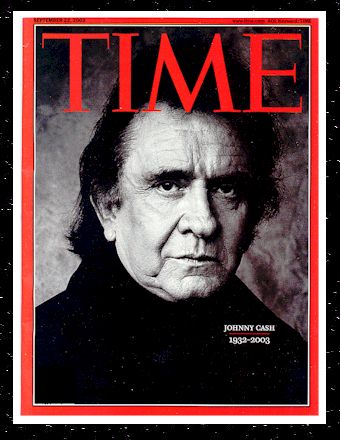
Johnny Cash, wife win posthumous Grammys
By Dean Goodman, Reuters
LOS ANGELES (Reuters) - Late country music
icon Johnny Cash won a Grammy Award Sunday for a heartbreaking video clip
that served as a nostalgic farewell to his fans.
His wife, June Carter Cash, who died just a few months before he did last
year, also won a Grammy, in the traditional folk album category. Both
awards were accepted on their behalf by their only son, John Carter Cash.
Cash's clip for "Hurt," filmed at his home north of Nashville
less than a year before he died last September, won the Grammy for best
short form video, the first prize announced during the non-televised
portion of the ceremony.
A funereal tune about depression written in 1994 by Trent Reznor of hard
rock band Nine Inch Nails, "Hurt" was covered by Cash on his
last album, "The Man Comes Around," which has sold more than one
million copies in the United States.
"My father, he can take any song and make it his own," John
Carter Cash said. "To take a song of such gut-wrenching potential and
strength and fear and not lose his dignity is amazing."
June Carter Cash died in May, before the release of her third solo album,
"Wildwood Flower." Her son said she was able to hear the
recording and review the artwork for the album, which he described as
"a real labor of love."
His mother's cover of the Carter Family's "Keep on the Sunny
Side" was nominated for female country vocal performance. The Cashes
were also nominated for their duet on "Temptation," a contender
for the country collaboration with vocals category.
Johnny Cash already had 11 Grammys, including two he shared with June
Carter Cash. She won a Grammy in her own name for her 1999 solo album,
"Press On."
Filmed by director Mark Romanek in October 2002, the clip shows the frail,
white-haired "Man in Black" sitting at a table at his
Hendersonville, Tenn. home while June worriedly looks at him from a nearby
staircase. Some scenes were shot at Cash's nearby flood-damaged museum,
complete with broken artifacts such as a shattered gold record.
The video includes old footage from Cash's hellraising glory days,
including a jailhouse performance at San Quentin in the late 1960s.
Despite airing only once on MTV before his death, the clip picked up six
nominations at the music cable channel's annual Video Music Awards last
year.
In a major snub, it won just one prize, for cinematography, and Cash died
15 days later, on Sept. 12.
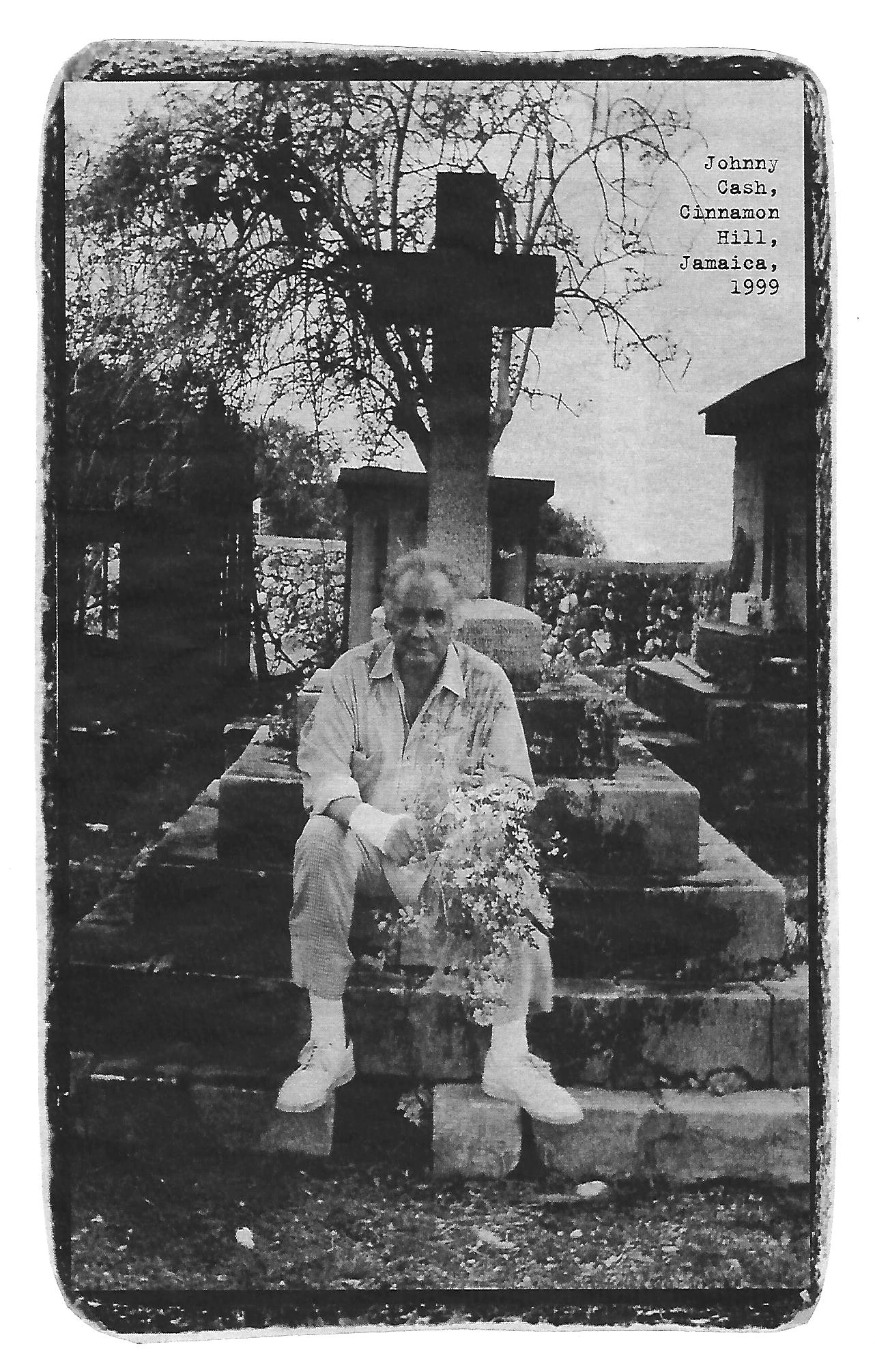
Tribute In Jamaica
A musical tribute to the late
Johnny Cash is among the highlights at the Air Jamaica Jazz & Blues
Festival taking place through Sunday (Jan. 25). Cash's home and property
in Jamaica is near the festival grounds in Montego Bay. Several of his
family and friends are expected to participate in the tribute. Kenny
Rogers and Nashville resident Michael McDonald are among those appearing
at the festival. Other performers include Alicia Keys, Bobby Womack,
India.Arie and Cassandra Wilson
1968 Un-Released Johnny Cash Concert
Cash Fan, Joe Brill. Joe is attempting to
get CBS to release a previously "unreleased" concert from 1968
held in Toronto, Canada. He would like all of us Cash fans to
contact the person listed at the bottom of his email so maybe we fans can
get the ball rolling so this concert does not go the way of the dinosaur
and be lost for eternity and catch dust on the shelf. Please read,
respond and forward to fellow Cash fans!
THIS IS VERY IMPORTANT AND
I ASK YOU TO GIVE IT SPECIAL ATTENTION;
In 1968 Johnny Cash performed a concert at O'Keefe
Centre in
Toronto, Canada and CBC (Canadian Broadcasting Company) recorded
(on
film) the entire concert. They even titled it O'Keefe Centre Presents:
THE LEGEND OF JOHNNY CASH but it was never televised nor released
commercially as they had originally planned because this was about the
same time as the video (now a DVD) JOHNNY CASH: The Man, His World and
His Music was released and that pulled the rug from beneath the whole
concept.
Well, this great piece of Cash entertainment has
thus been sitting on
the shelves of CBC for over 35 years now and when recently contact
them
regarding this footage the December '03 response was: "There are no
plans to release this special for sale to the general public, unless
there is significant public interest."
I was advised to contact another department at CBC
regarding this matter
to further pursue this idea and I did just that!
After a couple of emails to that department of CBC I received this
statement: "We have looked at the possibility of releasing O'Keefe
Centre
Presents: The Legend of Johnny Cash in the past, but a successful
business case could not be made for it.
HOWEVER, your email has brought it to our attention again and, with
changes in the music industry that are showing increased demand for
video/DVD content and with the passing of Mr. Cash last year, we will
revisit the program.
We will, however, reassess the production and see if a video/DVD release
would be viable."
So, they are at least considering the idea and I
would ask ALL true Cash
fans to send a email or better yet write a letter
stating that they
would be more than happy to purchase such a video/DVD if they would
produce one. I would like to see them receive thousands of
letters/emails letting them know there is a huge market there for such
an item should they decide to produce it.
This was a period in Johnny's life when he was absolutely in his prime
years and it is a "live" performance from that time.
OK--Enough said contact every and all Cash fans you know and tell them
the news and to get in touch with CBC ASAP by mail or email.
The name of the contact person is:
Karen Bower
Manager
CBC Non-Broadcast Sales
Her email address is:
Karen_Bower@cbc.ca
|