Johnny
Cash
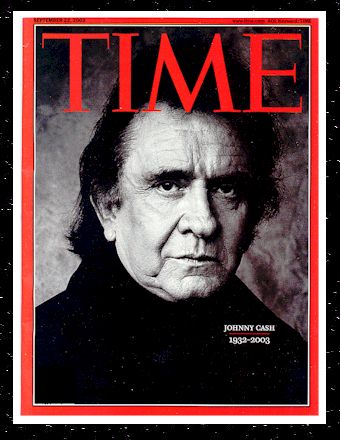
1932 - 2003
Rolling Stone Magazine Article's

For The Week Of September
28 2003
Bob Dylan
I
was asked to give a statement on Johnny's passing and thought about
writing a piece instead called "Cash Is King," because that is
the way I really feel. In plain terms, Johnny was and is the North Star;
you could guide your ship by him -- the greatest of the greats then and
now. I first met him in '62 or '63 and saw him a lot in those years. Not
so much recently, but in some kind of way he was with me more than people
I see every day.
There
wasn't much music media in the early Sixties, and Sing Out! was the
magazine covering all things folk in character. The editors had published
a letter chastising me for the direction my music was going. Johnny wrote
the magazine back an open letter telling the editors to shut up and let me
sing, that I knew what I was doing. This was before I had ever met him,
and the letter meant the world to me. I've kept the magazine to this day.
Of course, I knew of him before he ever heard of me. In '55 or '56,
"I Walk the Line" played all summer on the radio, and it was
different than anything else you had ever heard. The record sounded like a
voice from the middle of the earth. It was so powerful and moving. It was
profound, and so was the tone of it, every line; deep and rich, awesome
and mysterious all at once. "I Walk the Line" had a monumental
presence and a certain type of majesty that was humbling. Even a simple
line like "I find it very, very easy to be true" can take your
measure. We can remember that and see how far we fall short of it.
Johnny
wrote thousands of lines like that. Truly he is what the land and country
is all about, the heart and soul of it personified and what it means to be
here; and he said it all in plain English. I think we can have
recollections of him, but we can't define him any more than we can define
a fountain of truth, light and beauty. If we want to know what it means to
be mortal, we need look no further than the Man in Black. Blessed with a
profound imagination, he used the gift to express all the various lost
causes of the human soul. This is a miraculous and humbling thing. Listen
to him, and he always brings you to your senses. He rises high above all,
and he'll never die or be forgotten, even by persons not born yet --
especially those persons -- and that is forever.
Merle Haggard
I
met Johnny in 1963 in a restroom in Chicago. I was taking a leak, and he
walked up beside me with a flask of wine underneath his coat and said,
"Haggard, you want a drink of this wine?" Those were the first
words he ever said to me, but I had been in awe of him since I saw him
play on New Year's Day in 1958, at San Quentin Prison, where I was an
inmate. He'd lost his voice the night before over in Frisco and wasn't
able to sing very good; I thought he'd had it, but he won over the
prisoners. He had the right attitude: He chewed gum, looked arrogant and
flipped the bird to the guards -- he did everything the prisoners wanted
to do. He was a mean mother from the South who was there because he loved
us. When he walked away, everyone in that place had become a Johnny Cash
fan. There were 5,000 inmates in San Quentin and about thirty guitar
players; I was among the top five guitarists in there. The day after
Johnny's show, man, every guitar player in San Quentin was after me to
teach them how to play like him. It was like how, the day after a Muhammad
Ali fight, everybody would be down in the yard shadowboxing; that day,
everyone was trying to learn "Folsom Prison Blues."
Then
when my career caught fire, he asked me to be a guest on his variety show
on ABC. He, June and I were discussing what I should do on the show, and
he said, "Haggard, let me tell the people you've been to prison.
It'll be the biggest thing that will happen to you in your life, and the
tabloids will never be able to hurt you. It's called telling the truth: If
you start off telling the truth, your fans never forget it." I told
him, "Being an ex-convict is the most shameful thing. It's against
the grain to talk about it." But he was right -- it set a fire under
me that hadn't been there before.
We
knew he'd been sick, and we'd thought he was going to die so many times
over the last couple years -- if you want to get really serious, he'd been
near death for decades. Johnny Cash lived in constant, serious pain: On a
scale of one to ten, it was somewhere around an eight for the last eight
years of his life. He dealt himself some terrible years where he didn't do
the right things. He didn't eat right, so his bones got brittle; his jaw
broke during some dental surgery and never healed. He lived as an example
of a man in pain, going from one stage of bad health to another, but he
held his head up the whole way. He was like Abraham or Moses -- one of the
great men who will ever grace the earth. There will never be another Man
in Black.
Kris Kristofferson
I
was his janitor for a year and a half at Columbia Records Studio, and I
pitched John every song I ever wrote. He never cut any of them then, but
he was always encouraging. He even carried one set of my lyrics around in
his wallet, and at the time that was enough for me. Then when he got his
television show, it was a really important phase in the development of
country music here in Nashville. He brought in a lot of people who weren't
normally in Nashville, like Joni Mitchell, Linda Ronstadt, James Taylor,
Ray Charles. He put me on the show, too, and he recorded my song
"Sunday Mornin' Coming Down" and made it Record of the Year. I
never had to work another job again.
John
was my hero a long time before I ever met him. He represented so much that
appealed to me -- like freedom. He was willing and able to be the champion
of people who didn't have one. And I think the power of his performance
came from the tension between this man who was deeply spiritual and also a
real wild man. I can see how rappers would love that "I shot a man in
Reno"
attitude. But to me, he doesn't represent danger, he represents integrity.
And, Jesus, that's just what we can't afford to lose today.
Bono
Every
man could relate to him, but nobody could be him. To be that extraordinary
and that ordinary was his real gift. That, and his humor and his
bare-boned honesty. When I visited him at home one time, he said the most
beautiful, poetic grace. He said, "Shall we bow our heads?" We
all bowed our heads. Then, when he was done, he looked at me and Adam
Clayton and said, "Sure miss the drugs, though." It was just to
say, "I haven't become a holy Joe." He just couldn't be
self-righteous. I think he was a very godly man, but you had the sense
that he had spent his time in the desert. And that just made you like him
more. It gave his songs some dust. And that voice was definitely locusts
and honey. As for "Hurt," it's perhaps the best video ever
made.
I
was telling somebody just the other day, "We're all sissies in
comparison to Johnny Cash." And he was a zookeeper, too. Did you know
he was nearly killed by an emu on his property? He told me, "That emu
damn near killed me. I defended myself with a post." But he was
laughing as he told the story.
So
Johnny Cash passed away after seeing off the love of his life. That's such
a different outcome than death by emu. We should be grateful.
Al Gore
When
I was elected to congress twenty-seven years ago, my district included
Johnny Cash's home in Hendersonville, twenty-five minutes north of
Nashville. Back then, there was only one personal connection, through June
Carter Cash, whom my father had known when she was a girl performing with
her legendary family on WSM radio.
As
I got to know Johnny Cash the man, I loved his music much more -- not for
the normal reason that you appreciate the work of your friends, but
because it was just obvious at close range that what made his songs so
great was that the man himself was deep, deep, deep.
He
had felt a lot of pain in his life (though he told me a few months ago
that the worst pain he ever felt was when he lost June last May). But
midway through his life, he found the strength to learn from his mistakes,
acknowledge them honestly and transcend them.
And
maybe because of what he had gone through, he felt a deep connection to
the suffering of others. He was to the left of me on many issues; for
example, he was against the death penalty. He cared about social
conditions and wanted laws and policies that would help the poor and
disadvantaged. You could always tell when he talked about what was going
on in America that he cared most of all for those who have a tough row to
hoe.
To
my ears, his songs have always been beautiful, powerful and moving in a
completely original way. In fact, I remember arguing with Rolling Stone's
critic who reviewed Johnny's last album with what I thought was too-faint
praise. His music will grow considerably in stature as time passes. That
unusually strong connection between the soul of the artist and the
integrity of his art will lift it up and set it apart, and its rare beauty
will be more readily recognized, because it draws its power from that
shimmering link between song and soul.
Rick Rubin
(Producer, "American Recordings")
When
June passed away, he became more driven about work. I spoke to him -- he
was in the hospital room just after June had passed, and he really sounded
the worst I'd ever heard him. He said he had suffered a lot of pain in his
life, and this was by far the worst he'd ever had to deal with. But the
next day he said, "I want to get back into work, and I want to work
every day." He booked a session for three days after June passed
away. He said, "I don't want to do any of the things some people do
when they lose their partner -- I don't want to go out and spend a lot of
money. I don't want to meet girls. I don't want to do anything of this
world. I want to make music and do the best work I can. That's what she
would want me to do, and that's what I want to do." Some days he'd
book a session and he wouldn't be well enough to sing. Other days, he
would go three or four days of singing and take a couple of days off to
rest. When he was too ill to leave the house, we would move the equipment
into the house and record. The last session that I did, two or three
months ago, was in one of the bedrooms. The last six months, we were
recording really heavy old blues-based things like "Ain't No Grave
Gonna Hold My Body Down" and "John the Revelator." He was
humble, someone who fought to be ego-less. He strove to be the best he
could at all times. And clearly, if you look at his history, he didn't
always succeed. His life is like a tug of war. For the time that I was
with him, the last ten years or so, I think he was on the winning side of
the rope.
Jerry Lee Lewis
I
did my first tour ever with Johnny Cash -- way back in 1956. It was me,
him and Carl Perkins, a thirty-day tour all the way through Canada, and
there weren't any paved highways or anything, nothing but gravel roads. I
remember what a great showman Johnny was. The way he sang was completely
different, and he had a whole different style that he created
himself.
John,
Elvis and them were rockabilly; I was rock & roll. But we all had
country in us, which manifested itself in different ways. If you break it
all down to the nitty-gritty, we're all country people. We were called
rebels -- I guess because we were. Whatever we took a notion to, we just
did it. John was religious-thinking, if not always religious-acting. One
of the most ridiculous things Johnny and I ever did was steal a television
set out of a hotel; there was a little bitty television up on the wall,
and we got it off. Johnny wanted it for his wife; I helped him get it,
because I didn't see any reason why he shouldn't have it.
I
hope when his heart quit beatin' that he was ready to meet his Maker. I
don't know if he was; I'm not the judge. He was a man of faith, which I
think should help. I just hope he made it through the gates.
Marty Stuart
Merle
and I have been touring together all summer, and the first show was the
first annual Merle Haggard UFO Music Fest, in Roswell, New Mexico. You'll
be happy to know that Johnny Cash went to heaven with a commemorative
Merle Haggard UFO Music Fest guitar pick. John would've appreciated the
gesture -- most people didn't know that side of him. Every December, he
and I would go to the graveyard to visit Luther [Perkins, Cash's original
guitarist] and bring him a cigarette. We would lay down on the grave,
smoke and talk to Luther, telling him what a lazy son of a bitch he was
for lying there while we were out touring, killing ourselves to promote
him.
When
I was in John's band during the Eighties, we were down to playing Branson,
Missouri-type shows for elderly people. Nashville was done with him.
Instead of giving him the respect he deserved, they treated him like a
fossil. But with the American Recordings album, his career had a rebirth
just by him doing what the fuck he wanted to do. He had a brand-new
audience, which put wind in his sail. He wasn't having to do his old
patriotic Johnny Cash tricks for a bunch of older Americans; it was kids
with tattoos and weird hair trying to find their way.
I
don't think he was scared of things. I don't think he was scared of death
or illness -- he'd been through all that. I saw him have to go to the
Betty Ford clinic after a farm animal punctured his stomach. He went back
on painkillers, and with us addicts, all it takes is one pill to set us
back. But I think he was scared most of losing people -- he lost his mom,
his dad, his wife -- and of the dark force of Satan. John fully understood
the power of the dark force. He'd be on his knees with a Bible in his
hands, trying to cope with his demons. He believed what he read in the
Bible and tried to practice it.
Emmylou Harris
I
was doing a show with Neil Young in Nashville
just after Johnny died. Before the show, Neil was telling me how sorry he
was about Johnny. And at the end of "Rockin' in the Free World,"
Neil played "Taps" on the guitar. It was beautiful. John seemed
so completely American -- if I might say that in a time of such turmoil
that I'm not sure we know who we are as a people. He seemed to be the
voice of truth in everything he did. There was nothing unnatural about
John Cash -- this was not an act. He rose to the occasion on The Man Comes
Around in a way that was astonishing. And the video they made of
"Hurt" puts all those bare-navel, soft-porn videos to shame. It
shows videos can actually have a profound effect on us, and it took Johnny
Cash to once again show that. It's come full circle, because when he first
came on the scene with that power, he was all that rock & roll could
be.
Mark Romanek
(Video director, "Hurt" )
The
sadness in the video is genuine -- Johnny said that "Hurt" was
the best anti-drug song he'd ever heard. The rage you see when he pours
the wine on the table or starts to weep is a direct result of having lost
people to addictions -- and almost having lost himself. But he was playing
a role. On set, when we yelled, "Cut," a very different, very
funny, much more energetic Johnny Cash emerged. When we were shooting the
piano scene, he said, "Maybe you want June to dance naked on the
piano there." June said, "Oh, John!" and the crew broke up.
He was playful with June -- the degree to which they were in love with
each other was palpable after all these years. Johnny was also extremely
generous -- he autographed about thirty-five vinyl copies of The Man
Comes Around as a parting gift to the crew, who were in awe. That had
never been done by any of the forty artists I've worked with.
Sheryl Crow
I
sang at John's funeral, and I cannot lie: It was very hard. There was a
real sense we had turned a corner. Because there can never be another
Johnny Cash. I grew up in a place where people were very God-fearing,
land-loving, and John represented the salt of the earth to me. He spoke
for every man and personified the human struggles that we all go through.
He was almost biblical, because he walked this earth and experienced all a
man could suffer. Yet he still rose up out of the ashes with this great
strength and gave voice to that strength for all of us.
Steve Earle
Johnny
Cash was one of the few people who wrote me when I was locked up -- he
sent me a very encouraging letter saying how everybody was pulling for me,
that he and June were praying for me and that he would see me when I got
out. I saw him again when I helped put together the band for his song on
the Dead Man Walking soundtrack. When I got to the studio, nobody
was there but John and the engineer. I walk in and there's this
old-fashioned picnic basket sitting in the middle of the pool table -- you
know, gingham tablecloth, the whole bit. John's got his hand in that
picnic basket, and he looks up and says, "Steve, would you like a
piece of tenderloin on a biscuit that June made this morning?" I was
really hungry, so I said, "Yeah," and he said, "I knew you
would." We could've talked about our shared demons -- I'd been clean
probably a year and a half -- but he knew that sometimes it's better to
leave some things private and just talk about tenderloin and
biscuits.
Tom Petty
The
first time I met John was in 1982. I was with Nick Lowe, who was his
son-in-law at the time, and we were in Nashville.
John invited us to have a meal at his place out on the lake. We arrived,
but we were disappointed, because John had taken ill that morning and had
gone to the hospital with pneumonia -- him and June. But the meal was
still going to go on. We sat at this long, elaborately set table. Just as
the meal was about to begin, someone said, "Tom, John's on the phone
and would like to talk to you." So I went to the phone, and we talked
for, God, about half an hour. Then after dinner, he and June spoke to
every single guest by phone as they left the house and asked if they had a
good time.
When
John came out to Los
Angeles
to make Unchained, me and the Heartbreakers kind of became his
band. I still view that as the best work we ever did. One of my favorite
stories is being at this studio in downtown Hollywood
-- which is kind of a weird neighborhood -- when John came in with June.
He was laughing, so I said, "Hey, where you been?" He said,
"June and I thought it would be fun to just sit on that bus bench
across the street for a while. I met the most interesting people over
there." I said, "You're kidding me." I was trying to
picture the look on these people's faces as they came to wait for the bus,
and there's Johnny and June. This guy was friends with presidents, and he
was friends with people at the bus stop.
Reporting
by Anthony DeCurtis, Matt Diehl, Austin Scaggs and David Wild
Rolling Stone Magazine Article's
October 26,
2000

October 26,
2000
ROLLING
STONE REVIEW (3 STARS)
Johnny Cash's best albums -- from his 1957 rockabilly-folk debut, With His
Hot and Blue Guitar, to his 1964 collection of American Indian ballads,
Bitter Tears, to his rousing 1968 live set, At Folsom Prison -- are bona
fide American classics. But Cash's catalog is massive, and he has made as
many kitschy, tossed-off records as he has good ones.
When Cash teamed up with hard-rock/hip-hop producer Rick Rubin for
American Recordings in 1994, the duo stripped the post-Seventies studio
excess from Cash's deeply moving voice. The result was a spare beauty that
reintroduced the Man in Black to a new generation of fans who identified
with the pain and loneliness at the core of his music.
But after three more similarly constructed albums, the American series has
run its course. Cover versions that once seemed inspired now feel somewhat
obligatory. Hearing him warble through Depeche Mode's "Personal
Jesus," on The Man Comes Around, you feel embarrassed for Cash and
angry with Rubin for bleeding the life out of this experiment.
Cash's duet with Nick
Cave
on
Hank
Williams' "I'm So Lonesome I Could Cry" is sluggish and
uninspired.
Not everything is irredeemable, though. Cash's harrowing take on Judgment
Day in the self-penned title track has everything he's best at: that deep,
pensive voice, gritty country-folk sound, his poignant rewriting of
Scripture, and topical significance. Even his duet with Fiona Apple on
Simon and Garfunkel's "Bridge Over Troubled Water" somehow
resonates in an increasingly unstable world.
What's clear is that Cash no longer needs Rick Rubin to tell him what's
cool. He's at his best when he's choosing his own songs and singing them
with conviction.
MARK KEMP
(RS 909 – November
14, 2002
)

To Order Back Issues Online
I Didn't Like That "Public
Figure " Business. I Am A Very Private Person. Many Times, When There
Would Be Something I'd Have To Do That I Didn't Have My Heart In, I'd Say,
"All I Ever Wanted To Do Was Play My Guitar And Sing A Simple
Song." And That's Still All I Want. Johnny
Cash

I Believe What I Say, But That
Don't Make It Right. There Is A Spiritual Side To Me That Goes Real Deep,
But I Confess I'm The Biggest Sinner Of Them All. Johnny
Cash


On a
sunlit afternoon, Johnny Cash sits in a large, comfortable chair in the Hendersonville,
Tennessee,
house he's shared with his wife, June Carter Cash, for more than thirty
years. He's reflecting on his life. In 1997, he announced that he was
struggling with a nervous-system disorder, and his public manifestations
since then have been rare. But this afternoon, he is expansive,
good-humored and, above all, indomitable as he talks about the album he is
recording, his plans and his past.
"This
room right here that you're in, this is the room I moved into when I
decided to quit drugs in 1968," Cash says as he looks around the
oval-shaped, dark-wooded den. "They didn't have treatment centers the
way they do now, so this is the room that I climbed the walls in for
thirty days.
"The
doctor came to see me every day at 5
p.m.," he continues.
"The first few days I was still rollin' stones. Amphetamine was my
drug of choice, and I had pills hidden all over this room." He looks
over to the many doors that line the wall opposite the row of windows
overlooking Old
Hickory
Lake.
He pauses, then laughs to himself. "I was serious about quitting --
but not quite," he says, wryly. "About the third or fourth day,
the doctor looked me in the eye and asked, 'How you doin'?' I said,
'Great!' And he said, 'Bullshit. I know you're not doing great. When are
you going to get rid of them?' So I went and got them out of the closet
and wherever else I had them hid, and we flushed them. Then I really
started the program that he laid out for me. I came out of here feeling
like a million dollars."
Being
around Johnny Cash is a daunting experience. He is tall, and, though the
illness he now lives with has broadened him around the middle and grayed
that sleek mane of black hair, he remains a formidable physical presence.
As he talks, he will occasionally put his hands over his eyes and rub
them, as if he is in pain. Those eyes look as though they have seen
everything, have absorbed all the lessons those experiences had to offer
and now are hungry for more. His intelligence is keen, and his innate
dignity informs every move he makes and every word he speaks. It is
heartbreaking to watch him, a giant, struggle with his burden. The
knowledge that Cash has walked both sides of the line separating sin and
salvation only thickens the air of integrity that always surrounds him.
Right now, in the bright sunshine outside, a celebration is under way on
the sprawling grounds of the Cash estate, just north of Nashville. Several
hundred people -- including such Nashville luminaries as George Jones, Tom
T. Hall and Skeeter Davis -- have gathered to celebrate the release of
June Carter Cash's Press On,
a moving collection of songs that honors her heritage as a daughter of the
Carter Family, the founding family of country music. But while the
festivities go on, guests are quietly led back to the house for private
audiences with Johnny. He's friendly to everyone, but he's pacing himself.
He plans to perform a song with June in an hour or two, and he needs to
conserve his energy.
In
October 1997 Cash grew dizzy and nearly fell after bending down to
retrieve a guitar pick during a performance in Flint, Michigan.
He then told the audience that he had Parkinson's disease. Shortly
afterward, he was diagnosed with Shy-Drager Syndrome, a progressive,
Parkinson's-like illness for which there is currently no cure. The
prognosis is terrifying: chronic degeneration over a period of years, then
death. Cash canceled the remainder of that '97 tour. He has subsequently
been hospitalized a number of times for pneumonia, and he has suffered
other side effects of the disease and its rigorous treatment. Cash has
fought his illness with characteristic will -- so much so that there is
now some question about whether the diagnosis of Shy-Drager is correct.
While he suffers many bad days -- and neither his doctors nor anyone in
the Cash camp will publicly venture a more optimistic read on his health
-- Cash has fared far better than anyone had a right to believe he
would.
It's
hardly surprising, under such circumstances, that Cash's mind would turn
to an earlier physical struggle -- his tormented battle with drug
addiction, a battle that, despite some notable backsliding, he eventually
won. He does not like discussing his sickness. "It's all right,"
he assured the Michigan crowd after revealing his illness. "I refuse
to give it some ground in my life." In the spring of 1999 he told USA Today,
"I've made it a point to forget the name of the disease and not to
give it any space in my life, because I just can't do it. I can't think
that negatively. I can't believe I'm going to be incapacitated. I won't
believe that." After that article appeared, Cash was so upset about
its detailed discussion of his illness that he canceled some upcoming
interviews.
Back
in Hendersonville,
Cash eventually leaves the house and, dressed in black tails and a black
shirt, greets the family members, friends and guests who, to a person, are
thrilled to see him. He takes the stage set up in the yard and
affectionately introduces June. He looks flushed, and he moves with great
deliberateness, spending his store of energy carefully, anticipating the
exhaustion to come. Johnny joins June and her band -- which includes their
son John Carter Cash on acoustic guitar -- to duet with June on "The
Far Side Banks of Jordan," a tune that Cash first played for his wife
twenty-five years before, telling her, "This is going to be our
song." It's the sort of folk spiritual he used to sing with his
family on their front porch in Dyess, Arkansas,
decades ago, the kind of song that first sparked his love for music. He
begins the song, accompanying himself on acoustic guitar. "I believe
my steps are growing wearier each day," he sings. "Got another
journey on my mind/The lures of this old world/Have ceased to make me want
to stay/And my one regret is leaving you behind."
Johnny
and June harmonize on the chorus: "I'll be waiting on the far side
banks of Jordan/I'll
be sitting, drawing pictures in the sand/And when I see you coming/I will
rise up with a shout/And come running through the shallow water/Reaching
for your hand."
Despite,
or perhaps because of his illness, interest in Johnny Cash's music has
reached a fever pitch. In May, Columbia/American/Legacy released an
extraordinary three-CD box set of his work. Titled Love
God and Murder, it is a thematically organized collection that
explores the three grand subjects of Cash's forty-six-year career. Cash
has also just released a stunning new album, American
III: Solitary Man, his third collaboration with producer Rick
Rubin. It is a brave, unflinching confrontation with his own mortality,
the nearly inconceivable notion of leaving behind all the joys and sorrows
that constitute a life. It's hard to imagine anyone else making an album
remotely like it.
Like
so many of the titanic heroes of rock & roll, Johnny Cash is a
glorious mess of contradictions. The wild drugs and debauchery of Saturday
night -- and in Cash's case, pretty much every other night, too -- have
fought vigorously for his soul against the powerful Christian conviction
of Sunday morning. Cash is the Man in Black, the noble outlaw, a fearsome
figure whose Mount Rushmore face, piercing dark eyes and uproarious
excesses helped make him one of the more combustible ingredients in the
critical mass that exploded in Memphis in the mid-Fifties. In early songs
like "I Walk the Line" and "Big River,"
he articulated a fierce vision of what country music -- and its bastard
child, rock & roll -- could be. He hammered out a sound that is bare
to the bone, without a single wasted note.
"As
far as early rock & roll goes," Richards continues, "if
someone came up to me and for some reason they could only get a collection
of one person's music, I'd say, 'Chuck Berry is important, but, man,
you've got to get the Cash!' " While he was making that
groundbreaking music, Cash was also inventing what would soon become the
myth of Johnny Cash. It is a larger-than-life persona that has had at
least as much impact and influence as the music itself. "I was
backstage at the Grand Ole Opry in Nashville
when I met him in 1965," says Kris Kristofferson, whose career Cash
helped to launch. "It was back in his dangerous days, and it was
electric. He was skinny as a snake, and you just never knew what he was
going to do. He looked like he might explode at any minute. He was a bad
boy, he stood up for the underdog, he was exciting and unpredictable, and
he had an energy onstage that was unlike anybody else.
"I
shook hands with him," Kristofferson continues, "and that was
probably what brought me back to Nashville
to be a songwriter. He was everything I thought an artist ought to
be."
Folk
singer Eric Andersen remembers being introduced to Cash by Bob Dylan at
the Newport Folk Festival in 1964. Dylan greatly admired Cash, and Cash,
breaking ranks with Nashville orthodoxy, was an early, enthusiastic
supporter of Dylan. "I was backstage, and Bob ran over and grabbed
me," Andersen recalls. " 'You've gotta meet Johnny Cash, man!'
Cash was a hero to us, one of the original cats. So Bob brought me back to
his tent, and I met John. He had just done his set, and he was really
wired. He looked like a puppet whose strings were all tangled up -- half
cut, and half held together -- and he was just jiggling
around."
That
darker, uncontrolled side of Cash has drawn generations of fans to him
even as many of his contemporaries -- and their progeny -- have fallen out
of favor. He is, after all, the man who, in "Folsom Prison
Blues," sang, "I shot a man in Reno/Just to watch him die"
in 1955, decades before gangsta rap was born. He demolished hotel rooms
and stomped out the lights on the stage of the Grand Ole Opry while Keith
Moon was still in short pants.
Those
experiences also make Cash, who is now sixty-eight, sympathetic when
younger musicians are attacked for causing violence by singing and rapping
about it in their songs. "I don't think music and movies have
anything to do with it," Cash says, when asked about the relationship
between violence and popular culture. "I think it's in the person. I
mean, I'm an entertainer. 'I shot a man in Reno
just to watch him die' is a fantasy. I didn't shoot anybody in Reno -- and
I didn't kill Delia," he adds with a chuckle, alluding to a grisly
folk song he adapted on his 1994 American
Recordings album.
"But
it's fun to sing about those things," he continues. "Murder
ballads go way back in country music. Even the Carter Family, they got
some really bloody records. There's 'The Banks of the Ohio' with all that
'stuck a knife in her breast and watched her as she went down under the
water, and the bubbles came up out of her mouth, and the water turned
red.' And Jimmie Rodgers -- 'I'm gonna buy me a shotgun/Just as long as
I'm tall/And I'm gonna shoot poor Thelma/Just to see her jump and fall.'
That's right up there with 'shot a man in Reno.'
"But these songs are just for singing, and singers always knew that.
I'm not suggesting that anybody consider learning how to shoot a gun. I'm
not suggesting that they even own one. Although I do. I used to collect
antique Colt pistols. But they weren't for shooting. They were like
ancient coins -- I collect those, too. But the coins aren't for spending,
and the guns aren't for shooting." Inevitably, the discussion about
violence leads to the deeply held religious beliefs that are the other
pull in Cash's divided soul. They are the salve to the urges most aptly
described in the title of a Nick Lowe song he covered a few years back:
"The Beast in Me." "There's something missing there,"
Cash says. "There's a spiritual hunger in people for goodness and
righteousness. There's an emptiness in people that they're trying to fill.
And I don't know why they go about it the way they do."
Bono
recalls visiting Cash in Hendersonville
during a drive across the U.S. He and U2 bassist Adam Clayton sat down for
a meal with Johnny and June. "We bowed our heads and John spoke this
beautiful, poetic grace," Bono says, "and we were all humbled
and moved. Then he looked up afterwards and said, 'Sure miss the drugs,
though.' "
Cash
is content to let his convictions, however conflicted, speak for
themselves. "I believe what I say, but that don't necessarily make me
right," he says, laughing. "There's nothing hypocritical about
it. There is a spiritual side to me that goes real deep, but I confess
right upfront that I'm the biggest sinner of them all." He even views
his battle with drug addiction in spiritual terms. "I used drugs to
escape," he says quietly, "and they worked pretty well when I
was younger. But they devastated me physically and emotionally -- and
spiritually. That last one hurt so much: to put myself in such a low state
that I couldn't communicate with God. There's no lonelier place to be. I
was separated from God, and I wasn't even trying to call on him. I knew
that there was no line of communication. But he came back. And I came
back."
That
sense of spiritual wisdom garnered through grueling experience has given
Cash the moral strength, as an artist and a person, to always stand his
ground. Throughout his life Cash has pandered to no specific audience or
constituency. In the Sixties and early Seventies, he performed for
American troops and protested the Vietnam War. He defended Native American
rights long before it became fashionable. He has both played in prisons
and supported organizations that assist the families of slain police
officers. And he stands by his friends. "I opened for John in
Philadelphia a few years ago, and I dedicated a song to Mumia Abu-Jamal,"
Kristofferson recalls. Abu-Jamal is an African-American journalist who is
currently on death row for allegedly murdering a police officer -- in
Philadelphia. His case has become a flash point for activists, who believe
Abu-Jamal was railroaded and who want him to get a new trial. It's a flash
point as well for law-enforcement organizations, who view him as a
coldblooded killer. "The police at the show went ballistic,"
Kristofferson continues. "After I came off, they said that I had to
go out and make an apology. I felt pretty bad, because it was John's show.
But John heard about it and said to me, 'Listen, you don't need to
apologize for nothin'. I want you to come out at the end of the show and
do "Why Me" with me.' So I went out and sang with him. John just
refuses to compromise."
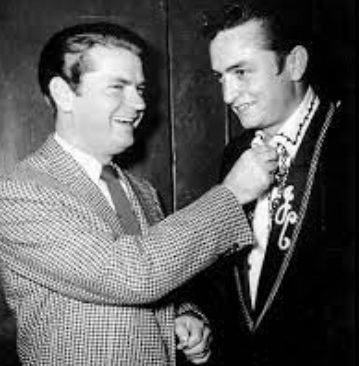
Johnny
cash became a superstar in his mid-twenties, enjoying an impressive run of
hits between 1956 and 1958 on Sun Records, the Memphis label run by Sam
Phillips, the man who originally signed Elvis Presley. Like Presley, Cash
soon left Sun to sign with a major label, in his case, Columbia. On Columbia,
his success continued, beginning with "All Over Again" and the
classic "Don't Take Your Guns to Town" in 1958. "Ring of
Fire" (1963) was his next major hit, and it's a song with a gripping
story behind it.
Cash
first laid eyes on June Carter when, on a high school class trip, he saw
her perform with the Carter Family at the Grand Ole Opry. He liked what he
saw then, and when he met her in person backstage at the Opry six years
later, he told her, "You and I are going to get married
someday." June laughed and said she couldn't wait. The only problem
was she already was married. In his autobiography Cash deadpans: "She
was either still married to Carl Smith or about to be married to Rip Nix,
I forget which. . .
Of
course, Cash was married himself, so nothing much happened until 1962,
when June joined Cash's road show. "We got married in a fever/Hotter
than a pepper sprout," the two would sing in "Jackson," the
song that became their signature, and from the start the attraction
between them was strong and undeniable. Composed by June and country star
Merle Kilgore, "Ring of Fire" is the story of those first,
overwhelming feelings of danger, lust and love. June, after all, was a
daughter of country royalty, and Cash, his addictions raging, had already
more than earned his wild-man rep. "Love is a burning thing,"
the song begins, "And it makes a fiery ring/Bound by wild desire/I
fell into a ring of fire."
"I
never talked much about how I fell in love with John," June recalls
about writing the song. "And I certainly didn't tell him how I felt.
It was not a convenient time for me to fall in love with him -- and it
wasn't a convenient time for him to fall in love with me. One morning,
about four o'clock,
I was driving my car just about as fast as I could. I thought, 'Why am I
out on the highway this time of night?' I was miserable, and it all came
to me: 'I'm falling in love with somebody I have no right to fall in love
with.' "I was frightened of his way of life," she continues.
"I'd watched Hank Williams die. I was part of his life -- I'm Hank
Jr.'s godmother -- and I'd grieved. So I thought, 'I can't fall in love
with this man, but it's just like a ring of fire.' I wanted so to play the
song for John, but I knew he would see right through me. So I gave it to
my sister Anita, and she recorded it -- her version was like a folk song,
like bells ringing in the mountains. When John heard it, he said, 'I want
to do that song.' "
"But
the 'ring of fire' was not the hell," he continues. "That was
kind of a sweet fire. The ring of fire that I found myself in with June
was the fire of redemption. It cleansed. It made me believe everything was
all right, because it felt so good. When we fell in love, she took it upon
herself to be responsible for me staying alive. I didn't think I was
killing myself, but you're on the suicide track when you're doing what I
was doing. Amphetamines and alcohol will make you crazy, boy!
"She'd
take my drugs and throw them away, and we'd have a big fight over it. I'd
get some more, and she'd do it again. I'd make her promise not to, but she
would do it anyway." He laughs. "She'd lie to me. She'd hide my
money. She'd do anything. She fought me with everything she
had."
By
the time June and Johnny got married in 1968, his career had reached
another peak. The live album he released that year, At Folsom Prison, sold
extremely well. Then, in 1969, he enjoyed the biggest hit of his career,
albeit with a novelty song, Shel Silverstein's "A Boy Named
Sue." He began hosting his own network television series, The Johnny
Cash Show, and used it as a forum for a bold array of musical talent, from
Bob Dylan (who appeared on the opening show) to Louis Armstrong, Pete
Seeger, Linda Ronstadt and Carl Perkins.
As
the Seventies progressed, however, Cash's star waned. Early in the decade,
the singer-songwriter movement in rock and the outlaw movement in country
provided him with aesthetic vindication and a raft of spiritual heirs. But
he shared nothing with later phenomena like disco and the urban-cowboy
craze, and the connections between his music and punk rock would only
become apparent later. The glitz-obsessed Eighties and the onslaught of
MTV did little to help matters. Cash made some strong albums in this
period -- and some bad ones -- but he seemed to have lost his artistic
compass.
He
remained a powerful draw on the road, however, and in 1985 he joined the
Highwaymen, an occasional alliance with Willie Nelson, Waylon Jennings and
Kris Kristofferson that would continue until the onset of his illness. In
the meantime, Rosanne Cash, a daughter from his first marriage, and June's
daughter Carlene both launched their own musical careers. As often is the
case with children of the greats, rebellion and resentment battled love
and support on all sides. Carlene's insistence, for example, that she
wanted to put "the cunt back in country" was obviously designed
both to shred the Carter Family mantle and to crack the iron reserve of
her mother's husband. It worked on both counts. For her part, Rosanne
remembers her struggle to escape her
father's looming shadow. "I was very rebellious," she says.
"I couldn't stand the constant references to him. I wanted to do it
on my own. That's not unlike any person in their early twenties, but it
just so happened that my dad was very public so I had to rebel a little
harder -- and I rose to that test [laughs]." That her father was
experiencing his own career woes only exacerbated the situation.
"When I was having hit records, my dad and I felt competitive with
each other," Rosanne says. "He admitted it later. I mean, he
would ask me about my contract and how many points I was getting [laughs].
We went through that phase. But when he felt that I was pulling away from
him, he gave me a lot of space. I think it probably hurt him
some."
Cash
regained a focus in his work after meeting producer Rick Rubin in the
early Nineties. Rubin had made his reputation with albums by LL Cool J,
Public Enemy and the Beastie Boys, but he was determined to sign Cash to
his label, American Recordings. Cash had no idea who Rubin was or what
conceivable interest the producer could have in him. "From the very
beginning, I couldn't see what he saw in me," Cash says, bluntly. But
Rubin felt he understood exactly who Johnny Cash is. "He's a timeless
presence," Rubin says. "From the beginning of rock & roll
there's always been this dark figure who never really fit. He's still the
quintessential outsider. In the hip-hop world you see all these bad-boy
artists who are juggling being on MTV and running from the law. John was
the originator of that."
The
three albums Cash and Rubin have made together, American Recordings (1994), Unchained (1996) and, now, Solitary Man, have helped Cash discover a voice suitable both to
a man of his age, disposition and accomplishments and to contemporary
times. American Recordings
received a Grammy for Best Contemporary Folk Album, while Unchained won
for Best Country Album.
"From
the first day, working with Rick has been easy, laid-back, relaxed and
trustworthy," Cash says. "We trusted each other to be honest. I
said, 'I'm gonna sing you a song and if you don't like it, you tell me.
And if you got a song that you like and I don't, you've got to listen to
me. I can't sing it if I don't like it.' But he's come up with some really
fine songs, and he never pushed anything on me. We get along
beautifully."
Solitary Man typically
reflects the wide range of music that has shaped Johnny Cash's soul.
"There's a Bert Williams song written in about 1905 called 'Nobody,'
" Cash recounts. "You ever hear 'Nobody'? [starts to sing] I
ain't never done nothin' to nobody/I ain't ever got nothin' from nobody no
time/And until I get something from somebody sometime/I don't intend to do
nothin' for nobody no time." He laughs, clears his throat and begins
again: "When wintertime comes with its snow and sleet/And me with
hunger and cold feet/Who says, 'Here's two bits, go and
eat'?/Nobody."
He
laughs again. "It's a great old song," he says. "Then
there's a new song I'm recording next session called 'The Mercy Seat' --
it's a Nick Cave
song. And I'm writing three or four songs myself at the same time. It's
the first time I've ever had them bombard my brain like that. I hadn't
written for more than a year since I got sick, but when I started
recording, the ideas started coming. I'll finish them as we
work."
For
his part, Rubin also found some songs for Cash, including Neil Diamond's
"Solitary Man," which became the title track, and Tom Petty's
"I Won't Back Down," the album's opening song. Cash was unable
to put in long days in the studio, but, according to Rubin, his illness
didn't really affect their work together. "He's been fine; we just
have to take breaks," he explains. "Whenever he feels
comfortable, we record. It's been very pleasant."
The
process of working on the album energized Cash. Even the setting proved
restorative. "We're recording in a log cabin in the woods, right
straight across the road from my house," Cash says. "I built it
in '78, and it's just one room. It's got a kitchen, a bathroom off the
back and state-of-the-art equipment. We're surrounded by goats, deer,
peacocks and crows. We have to stop taping sometimes because the goats get
on the porch and tromp around."
Rubin
was similarly inspired by the locale. "It feels appropriate, him
singing these songs in that environment," he says of the studio.
"Lyrically, this album is intense, but musically it's relaxed.
"One
thing is a little bit different," Rubin adds a moment later, thinking
back to the question of Cash's health and its impact on their work.
"John is a little more self-conscious about his vocals. There's no
need for him to be -- they're spectacular. But when he listens to them, he
often feels, 'I can do better than that.' Meanwhile, everyone in the room
is like, 'That was amazing.' I think because he doesn't feel well
physically all the time, he's projecting that onto the work. But I don't
hear it. I hear these strong, beautiful songs.
"He
loves music -- it is his life," Rubin says. "After one session,
he said to me, 'You know, I think this is going to be my best album ever.'
He's made what, 200 albums? It's exciting to be around someone who's done
that much work and still wants to make his best album."
Grace
is a word that suggests both spiritual blessings and dignity of action,
and both those definitions fully apply to Solitary
Man.
He turns in a splendid version of U2's "One." His voice does
falter a bit on "I Won't Back Down," but while the song seemed
in search of a meaning when Tom Petty sang it (and Petty turns up on this
version as well), in Cash's hands it takes on a staggering gravity. That
refusal to go gently gets picked up in Will Oldham's scarifying "I
See a Darkness," on which Cash sings, "You know I have a drive
to live/I won't let go/But can you see/Its opposition comes rising up
sometimes. . . . And that I see a darkness?"
Cash
plans to start working on a new album right away. As Rick Rubin said,
music is Cash's life. "I didn't like that 'public figure'
business," Cash says. "I didn't like that 'American statesman'
stuff. I didn't like that 'great spiritual leader' stuff. I am a very
private person about those things. So many times, when there would be
something I'd have to do that I didn't have my heart in, I'd say, 'All I
ever wanted to do was play my guitar and sing a simple song.' And that's
still all I want to do."
These
days, Johnny Cash doesn't have to do anything he doesn't want to do. In a
merciless way, illness can clarify your life. "Yeah, well, most of 'em
are dead," he says with a grim insouciance when asked if he ever sees
any of the people with whom he helped create rock & roll. "Carl
Perkins and his brothers are all dead. Bill
Black. Elvis. Roy Orbison, who was not only my best friend, but my
next-door neighbor for twenty years.
"Of
the ones who are still left, I talk to Marshall Grant, who played bass for
me for so long. He and I are friends. [Producer] Jack Clement and I are
still really close. We don't really do a lot of 'good ol' days' sessions,
but if something comes up, we'll argue about who's right about it. But I
don't see many of them, no. I don't see many people at all since I got
sick."
The
Carter Family's staunch Appalachian will to survive courses in June's
blood, along with a Southern woman's determination to cheerfully make the
best out of whatever travails fate may bring. She is now seventy-one, and
her devotion to her husband is absolute. "Even now, since John's been
sick, we've just had so much fun," she says. "When he first got
ill, I said, 'We're going to quit work for a year, and then we'll see how
we feel.' And we'll quit another year if we want to. Who says we have to
work? We've got a lot of front porches -- we'll go sit on
them."
"There's
unconditional love there," says Cash about his marriage. "You
hear that phrase a lot, but it's real with me and her. She loves me in
spite of everything, in spite of myself. She has saved my life more than
once. She's always been there with her love, and it has certainly made me
forget the pain for a long time, many times. When it gets dark, and
everybody's gone home and the lights are turned off, it's just me and
her."
Johnny
and June spend as much time as they can with their family, and they travel
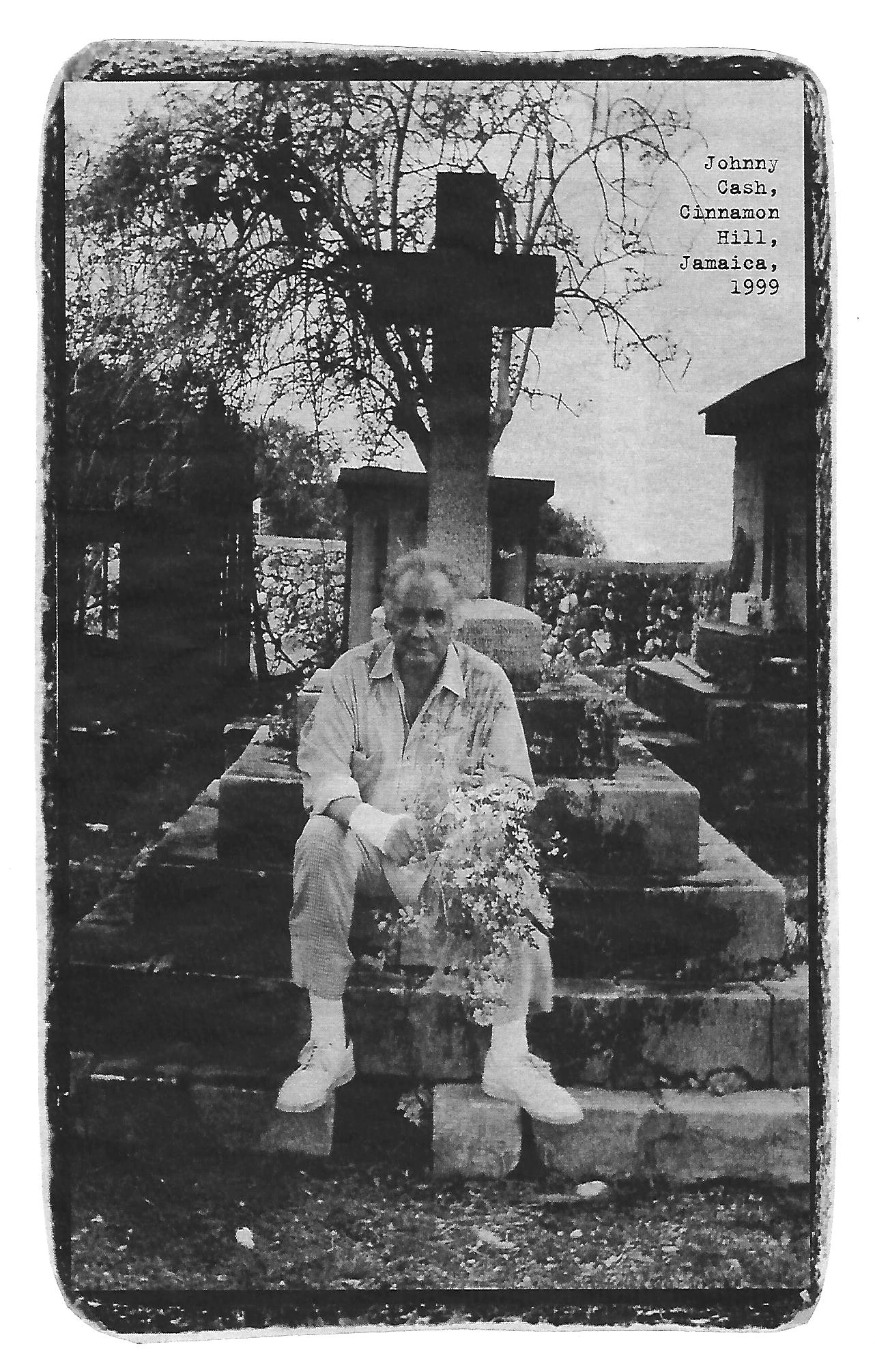
among their homes in Tennessee, Virginia
and Jamaica.
Despite being a longtime road horse, Cash will not be able to tour in
support of Solitary Man.
"It depresses him," says Rosanne. "He's not used to sitting
around. He's a very powerful person and to not feel well, that's really
hard for him. He spent over forty years on the road, and suddenly he's not
out there. When that energy comes to a screeching halt, there's a lot to
deal with just inside yourself."
Whatever he needs to deal with,
either inside or outside himself, Johnny Cash will make do and not
complain. He doesn't know any other way. "I wouldn't trade my future
for anyone's I know," he writes in the liner notes to Solitary
Man. "I believe that everything I've done and lived through is
what has brought me to this part of my life right now," he says, as
he looks around his den and remembers the many roads, rough and smooth,
he's traveled down. "I like to say I have no regrets. And I really
don't."

Larry
King Interview With Johnny Cash November 26 2002


CNN LARRY KING LIVE
Tonight Saturday August 30, 2003 ( Repeat )
Interview With Johnny
Cash
Aired
November 26, 2002
- 21:00 ET
THIS IS A RUSH TRANSCRIPT.
THIS COPY MAY NOT BE IN ITS FINAL FORM AND MAY BE UPDATED.
(BEGIN VIDEO CLIP)
JOHNNY CASH, SINGER: Hello, I'm Johnny Cash.
(END VIDEO CLIP)
(BEGIN VIDEO CLIP)
CASH: Hello, I'm Johnny Cash.
(END VIDEO CLIP)
(BEGIN VIDEO CLIP)
CASH: Hello, I'm Johnny Cash.
(END VIDEO CLIP)
(BEGIN VIDEO CLIP)
CASH: Hello, I'm Johnny Cash.
(END VIDEO CLIP)
LARRY KING, CNN HOST: Tonight, the man in black is back. An exclusive hour
with Johnny Cash next on LARRY KING LIVE.
(BEGIN VIDEO CLIP)
(SINGING)
(END VIDEO CLIP)
KING: The great pleasure to welcome a return visit to LARRY KING LIVE the
wonderful Johnny Cash. His new album, "The Man Comes Around"
will be out -- just came out November 4, as we play this on our
Thanksgiving holiday. And this past year we've seen the release of
"The Essential Johnny Cash," a two CD chronicle of his recording
years with Sun, Columbia and Mercury and the past year has also seen the release of an expanded
addition of five vintage Johnny Cash LPs put out on CD. You're like a --
you're a legend.
CASH: Well, there's a great compilation of my work that they've put
together, all the companies that I worked for, you know? And everybody is
trying to outdo the other one.
KING: You sang with Sun? CASH: Yes, I was on Sun Records.
KING: When Presley was there?
CASH: Yes, when Presley was there.
KING: You both sang for Sun Records?
CASH: Yes, right.
KING: Why didn't that company last forever?
CASH: Well, I don't know. It was a money thing, I guess. RCA- Victor went
to Sam Phillips to buy Elvis and they bought him. And he was the nucleus
of the whole thing -- the rockabilly thing was revolving around.
KING: Did you realize his greatness then?
CASH: I think so. I think everybody that saw him perform did, yes.
KING: Yes.
All right, Johnny, first and foremost, how are you doing? How's your
health?
CASH: Good. Good.
KING: Because, you know, you look like you've had some stuff times.
Explain.
CASH: I have had some tough times. I have had pneumonia three times in the
last three years -- four times in the last three years. And it debilitates
you. It takes the strength away. Took the life out of my legs and I can
walk, but not very well.
KING: Now, is this pneumonia related to that autonamic neuropathy (ph),
which you have.
CASH: Autonomic neuropathy.
KING: Which is what?
CASH: Well it's kind of -- the way I understand it, it's a deadening of
the nerve cells of the nerve endings in the lower extremities and
sometimes the hands and other extremities.
And for me that's really about the only thing it's really affected a lot.
I'm not sure that it's affected my lung power but I don't have the lung
power I did. But of course, pneumonia will take that away too.
KING: Now is the pneumonia an offshoot of that. Do you get pneumonia
because you have that disease? How did you first discover this? CASH:
Well, it was 1993 and I was hospitalized with a -- I went into a coma and
I was there for 12 days. They all thought I was dying and they couldn't
diagnose what was wrong with me. They finally came up with a diagnosis of
Shydreger (ph) Syndrome. It was few months later they realized I didn't
have that so it was Parkinson's. And then it was not that.
Then finally it was autonomic neuropathy.
KING: They finally got it right.
CASH: Finally got it right. And I'm pretty well resolved to the fact that
that's what it is. And it's a slow process of the nerve endings.
KING: No cure?
CASH: No, I don't think so. But that's all right. There's no cure for life
either.
KING: Can you sing?
CASH: Well, as well as I ever could I guess.
KING: You can? I mean, do you go out and sing?
CASH: Yes. Well, I don't go out and sing. I don't do concerts any more
because the physical thing of going out there and doing concerts and the
planes and the cars and the hotels and all that. And the backstage is
where it's so dark I have a hard time.
My vision is -- my vision is over. I'd probably say 60 percent gone
because of the neuropathy. And the diabetes.
KING: But you can still record.
CASH: Yes. I can still record, yes. I have been in the studio a lot. I
have focused my energies from the road to the studio and it really feels
good. I'm really enjoying it.
KING: Are you bitter?
CASH: Bitter? No.
KING: Angry? You're a young guy. You're only 70.
CASH: No, I'm not bitter. Why should by bitter? I'm thrilled to death with
life. Life is -- the way God has given it to me was just a platter -- a
golden platter of life laid out there for me. It's been beautiful.
I have been with you many times, Larry, and it's all been uphill every
time. You remember?
KING: Yes.
CASH: Yes, things have been good. And things will get better all time.
KING: So you have no regrets?
CASH: No regrets.
KING: And no anger at the, Why did God do this to me?
CASH: Oh, no. No. I'm the last one that would be angry at God. I'd really
took if I shook my fist at him.
KING: What was -- do you remember anything about being in a coma?
CASH: I remember voices in the room. I remember things they were saying.
And I couldn't respond to -- I was in a coma several times with -- over
the periods of time. It was actually three times with pneumonia. I was in
a coma several times -- with pneumonia three times. And several times I
wanted to wake up and tell them, I heard what you said, you know?. I'm not
dying.
KING: What's that feeling like?
I'm not dying. I could hear the people in the room rustling around and
talking. And after a while, you know, the conversation inevitably has to
come around to Well, if he dies, this or that, you know?
KING: Oh, and you're lying there hearing that?
CASH: And I'm lying there hearing that, you know? And I hear a lot of
that. I hear a lot of that...
KING: And you can't move?
CASH: ...over the days and nights. And I can't respond. No, I can't move,
no.
KING: How much of this do you think, Johnny, the disease, pneumonia,
trouble you've had in the '90s, can go back to your drug addiction, which
was in the '60s, right?
CASH:" I'm not going to blame it on that at all.
KING: No?
CASH: Not at all. The drug addiction, I won't blame this on drug addiction
at all.
And people say, Well, he wore that body out. Well, maybe I did. But it was
to a good purpose. They should be thankful that I wore it out to the
purpose I wore it out and that was writing and recording and touring and
doing concerts. Everywhere I could possibly do them that I thought I might
enjoy them. I thought people might enjoy me.
KING: You never stopped, did you?
CASH: I never stopped until 1993. No. Never.
KING: In the '60s your dependency was on what?
CASH: In the '60s, amphetamines and barbiturates.
KING: Amphetamines to stay up.
CASH: Uh-huh.
KING: Barbiturates to bring you down after you were up.
CASH: Right.
KING: Now what was it like performing when you were on drugs?
CASH: Well, for awhile it was OK. For awhile it was OK. For awhile, Larry,
when I took my first ones I said, this is what God meant for me to have in
this world. This was invented for me, you know? I honestly thought it was
a blessing -- a gift from God, these pills were.
And -- but then I thought -- then I finally found out I was deceiving
myself. That this was one of those things that have a false face -- that
it's the devil in disguise that has come to me.
KING: Make a nice song.
CASH: Probably been written but I'd write it.
KING: Was it hard to get rid of it?
CASH: To get rid of the pills? Yes. . It took -- the first time I broke
the addiction it took 32 days. And I was in a house that was unfinished. I
had just bought it. This was just before June and I were married.
And I was living in this house and she moved out there with her mother and
her father and several other people rallied around me and the commissioner
of mental health for the state of Tennessee, he had befriended me. And he
said, I will help you save your life if you want to save it. And I said, I
want to save it.
So he came to me every day at 5:00 when he got off work. He came every day
for a counseling session. For 32 days.
Only about the funny thing happened on about the seventh or eighth day. I
had these pills that I had rat holed, you know. I had hidden back that I
just knew nobody would know where they were.
KING: Safety measure.
CASH: Yes, my safety measure, yeah.
And one day about the fifth or sixth day he was out there, he said, OK,
how you doing? I said, just great. He said, no, you're not. You're lying.
I said, OK. He says where are they? You want to flush them or do you want
me to just leave and you keep taking them? I said, I'll flush them. So I
did. I flushed them.
KING: And stayed off it?
CASH: Stayed off of it, yes. For 32 days.
KING: More on the saga of Johnny Cash as we salute a true American legend
tonight on this special edition of LARRY KING LIVE. It's always good
seeing him as he keeps on keepin' on.
We'll be right back.
(BEGIN VIDEO CLIP)
(SINGING)
(END VIDEO CLIP)
(COMMERCIAL BREAK)
(BEGIN VIDEO CLIP)
(SINGING)
(END VIDEO CLIP)
(COMMERCIAL BREAK)
(BEGIN VIDEO CLIP)
(SINGING)
(END VIDEO CLIP)
KING: We're back with the incredible Johnny Cash, who keeps on, as we
said, keepin' on. And the lighter notes to the album "The Essential
Johnny Cash," Bono of U2 calls Cash the most male voice in
Christendom. Every man knows he is a sissy compared to Johnny Cash. Well
said.
How does that make you feel?
CASH: That embarrasses me. Sitting in front of you.
KING: Where did you start?
CASH: Where did I start? Memphis. Memphis, 1955.
KING: What was your first hit?
CASH: " Cry Cry Cry."
KING: Country hit, right?
CASH: Well, "Folsom Prison Blues" was my next record. It was the
first big country hit.
KING: How did you come to entertain in prison? How did that start for you?
CASH: Well, the convicts at Huntsville, Texas State Prison, had heard
"Folsom Prison Blues."
KING: Which was recorded in a studio?
CASH: Right, a studio recording. And this was 1956 I got the invitation to
do a concert at Huntsville, Texas. So the Tennessee Two and i, Marshall
Grant and Luther Perkins and I went down to Huntsville, Texas and set up
in the middle of the rodeo arena. They this big rodeo every year.
KING: Famous rodeo. Prison rodeo.
CASH: Well, just before the rodeo they had me out as a special attraction.
And I was out there supposedly to sing "Folsom Prison Blues."
(BEGIN VIDEO CLIP)
(SINGING)
(END VIDEO CLIP)
CASH: Well, we did "Folsom Prison Blues" and it started raining,
and a thunderstorm hit. We were right in the middle of the arena and the
rain is pouring down on our one little amplifier. In the middle of the
song it burns out. And I got no amplification, none whatsoever. And
there's thunder and lightning all around me. The men have been told not to
leave their seats but they all do. They all do. They walk down in the rain
to get close enough to hear me sing without the amplifier. And I sang that
song, and they demanded that I sing it again and again.
KING: In the rain?
CASH: In the rain. We all got soaking wet, but we had a great time. But
after that, Larry, I got a request from San Quentin, from the word got
around the prison grapevine that I was one of them I guess. But the word
got around in San Quentin, and they have that New Year's Day show every
year. I was invited to perform at that. So I started -- I made that an
annual event for about five years.
KING: Were you one of them?
CASH: Not really.
KING: Did you feel an affinity?
CASH: Well, only in my mind and in the songs I was singing.
KING: Obviously you had -- you were writing some of them, right? You
obviously had some contact with these men? What do you think it was?
CASH: Well, as I got into the '60s, yes, I began to have a lot of contact
with men from the steamy side of life, really from the steamy side of
life. When I got into drug addiction.
KING: So you could associate with them? There were guys in there for
drugs.
CASH: Yes, when you got thrown into jail a few times, and your head
knocked around a few times and your hands slapped with a black jack for
having on the bars (UNINTELLIGIBLE) you become -- get to thinking like
them, I guess.
KING: Did it harden you?
CASH: No, it didn't harden me. Not at all. I think it softened me. I think
it really softened me. I really do. I remember the last time I was in jail
before that time I told you about, you know when the commissioner of
mental health was out there every day. I came home from -- and seeking
help. But I came home from being in jail down in Georgia, in a little
county jail. And the jailer had picked me up and put me in his jail. I
didn't know about it. I didn't know a thing until I woke up the next
morning and here I am in jail.
I started banging on the bars, kicking the cell door, this and that, just
raising cane. He came down, got me up, brought me up to the front and he
threw my money and my car keys and my pills up on the counter. And he
said, here, you take it all. You take the pills, go ahead and kill
yourself if you want to. He said, it's your god given right to do that if
you'd like to do it. He said, I did the best I could do. I brought you in
to save your life, but now you go ahead and kill yourself or you go take
care of yourself.
I just put the things in my pocket and left. And I decided -- oh, he said,
also, he said, my wife is a big fan of yours and he said, when I went home
last night and told her I had Johnny Cash in my jail, she cried all night.
And he said, I don't want to see you any more. So get out of here.
KING: What did that do to you?
CASH: Well, that kind of -- you know, brought me down to about that tall.
KING: With all the things you had, it had to be rough, what am I doing
here?
CASH: Yes, right, you stupid.
KING: Johnny Cash is our guest. The man who doesn't go away. New albums,
new s and one of the great, great figures in American music history. We'll
be right back.
(BEGIN VIDEO CLIP)
(SINGING)
(END VIDEO CLIP)
(COMMERCIAL BREAK) (BEGIN VIDEO CLIP)
(SINGING)
(END VIDEO CLIP)
KING: Johnny Cash was presented by President George W. Bush in a ceremony
at Constitutional Hall in April with the National Medal of the Arts. He's
won every major award there is to win in music. He is an American
institution. When did you know you wanted to sing?
CASH: I knew I wanted to sing when I was a very small boy. When I was
probably 4-years-old. My mother played a guitar and I would sit with her
and she would sing and I learned to sing along with her.
KING: How would you describe your voice? Since there's no voice like it.
CASH: I don't know, Larry.
KING: I mean, it's not -- you don't hear yourself any where, right? I
mean, there's no one -- are you a bass?
CASH: I don't hear -- no, I'm not a bass. I don't hear me like anybody
else does. I'm sorry. I just don't. I don't hear -- I don't hear a good
strong voice. I guess I remember too much of the pneumonia. I don't know.
I just -- but my voice, I have to really work on my voice, on the vocals
on my records to get it right. I just -- I run out of air. I run out of
breath. And I run off pitch. I...
KING: So you have to go over it a lot?
CASH: Yes. Quite a bit. Quite a bit. Maybe no more than the average
person, but to me a lot, you know, who never had to do it a lot.
KING: Do you still enjoy singing?
CASH: I love it. I love it.
KING: What is it?
CASH: I love to go to the studio and stay there 10 or 12 hours a day. I
love it. What is it? I don't know. It's life.
KING: I mean, it must be -- with pneumonia is painful. It can hurt, right?
CASH: Yes, but what it did -- but I don't have pneumonia now. So it
doesn't hurt now to work that long.
KING: Do you miss audiences?
CASH: I miss the audiences. I miss the audiences. But I see enough of
people. You know where I see a lot of people? June and I go shopping a
lot. And... KING: Malls?
CASH: In malls. In malls. We love to go to malls. And some of the stores,
the big ones, have these little electric cars, little electric
wheelchairs.
KING: You ride them?
CASH: I'm dangerous on one of those things. Yeah. We go to these stores
I'll jump in one and follow June all day long in it. I love to shop.
KING: Where's home? Nashville?
CASH: Near Nashville. Hendersonville.
KING: Don't people stop you all the time?
CASH: Yes. That's all right.
KING: You don't mind it?
CASH: No, I don't mind.
KING: Why the black? Why do you always and only wear black?
(BEGIN VIDEO CLIP)
(SINGING)
(END VIDEO CLIP)
CASH: You know, I wrote a song about why I wear black but maybe that's not
quite it. I wear black because I'm comfortable in it. But then in the
summertime when it's hot I'm comfortable in light blue.
KING: I don't think I have ever seen you in light blue. Do you ever record
-- you ever do a concert in light blue?
CASH: No. Never done a concert in anything but black.
KING: Are you a clothes freak?
CASH: You walk into my clothes closet. It's dark in there. It's dark.
KING: How many records have you sold?
CASH: I don't know.
KING: Don't know. Biggest hit?
CASH: "I Walk The Line." "I Walk The Line." It was a
hit three times.
(SINGING) (BEGIN VIDEO CLIP)
(SINGING)
(END VIDEO CLIP)
KING: Tell me about the history of that song.
CASH: "I Walk The Line." I went to see -- let me see. Where did
the idea come from? Oh. I had a little recorder. I had a Wilcox Gay
Recorder -- a tape recorder in the Air Force in 1952. And I was always --
only guitar I was going do-do-do-do-do -- well it got turned around. The
tape got in there backwards. And hen I played it, it went sh-sh-sh-sh and
it had a kind of a drone sound like I finally had on the record.
But I couldn't figure out where that sound came from when I played it.
When I took that sound -- when I got home -- when I was home from the Air
Force, I was on the road and that sound was haunting me again. And then --
but then the line "because you're mine, I walk the line." It
kept coming to me, you know? But I was -- I was...
KING: It was coming to you?
CASH: ...young and not been married too long. yes, it kept coming to me.
Because you're mine, I walk the line. And then the words just naturally
flowed. It was an easy song to write.
KING: How about "A Boy Named Sue?"
CASH: That was Shel Silverstein song.
(BEGIN VIDEO CLIP)
(SINGING)
(END VIDEO CLIP)
KING: That song cracked up everybody whenever you sing it, right?
CASH: Right. Yes.
KING: Did you like it right away?
CASH: Right away. Immediately.
KING: Anyone else ever record it?
CASH: Nobody that I know of. Nobody that I know of. There's a thing about
that song. I recorded that live at San Quentin in 1969.
KING: I remember the album.
CASH: The night before I left home in Hendersonville to go to California
to do that concert, to make that record, we had a party at our house --
June threw a party for the cast of our TV show. And at the party was
singing these songs, all the songs for the first time was Bob Dylan sing
"Lay Lady Late At Night." Kris Kristofferson sang "Me and
Bobby McGee." Shel Silverstein sang "A Boy Named Sue."
Graham Nash sang "Marrakkesh Express."
KING: All of this...
CASH: Joni Mitchell sang "Both Sides Now." All these sons were
sung the first time at that party at my house that night.
We were leaving the next day to go to California and June said, Take the
words to "A Boy name Sue" to California. You'll want to record
that at San Quentin. I said, I don't have time to learn that song before
the show. And she said, Well, take them anyway.
So I did. I took the words to "A Boy Named Sue." I'd only read
it the first time -- sung it the first time the night before and I read it
off, you know, as I sing it. I still didn't know the words to it. So
reluctantly I put them in my briefcase and took them to California. And I
got out there to do that show. As a last resort, I pulled those lyrics out
and laid them on the music stand, and when it came time that I thought I
was brave enough, I did that song.
KING: And that crowd went berserk.
CASH: Yes, they went nuts.
KING: We'll be right back with more of Johnny Cash. Don't go away.
(BEGIN VIDEO CLIP)
(SINGING)
(END VIDEO CLIP)
(COMMERCIAL BREAK)
(BEGIN VIDEO CLIP)
(SINGING)
(END VIDEO CLIP)
KING: We're back with Johnny Cash. You're very involved in patriotism,
sing a lot of patriotic songs, get involved in your country a lot. Where
were you on 9/11?
CASH: I was at our farm in Middle Tennessee, little 107-acre farm,
watching television.
KING: You were up?
CASH: I was up watching television.
KING: Remember your first thoughts? CASH: A chill went over me. I just
thought, You know, it's an invasion. I felt like it was an invasion of
war, and it scared me. It really scared me. I just -- I thought what has
it come to, you know, that they can get away with this?
KING: Did people ask you to appear in any -- since you're not making
public appearances, just studio work, were you asked to appear in any of
the concerts and specials that were put on with regard to it?
CASH: Well, I don't know. I think I had a couple requests, but nothing I
seriously considered at all.
KING: Because you couldn't do it?
CASH: Right.
KING: Willie Nelson did some.
CASH: I think so. I think Willie did some, yes. Lot of the guys did.
KING: Now your singing contemporaries pass away -- I just want to get this
right. Waylon Jennings died in February battling diabetes, had part of a
foot amputated. You shared an apartment in the '60s. What was it like to
lose him?
CASH: Losing Waylon was a tough one. We were very close. We were very good
friends.
(BEGIN VIDEO CLIP)
(SINGING)
(END VIDEO CLIP)
KING: Were you poor together?
CASH: Well, not really, no. I wasn't poor. When we shared the apartment
together, I wasn't poor. I could have afforded a better apartment. I could
have afforded my own apartment without having to room with Waylon, but I
thought it would be fun, which it was. As it turned out, we kind of
drifted away from each other after a few short weeks in that apartment.
It really didn't work out, the two of us. What we did, we had this crash
pad that we shared, you know? A crash pad where we'd go crash from the
drugs, and we shared this thing. And also, we'd use this apartment as a
place to try to get June to come cook us some breakfast. She would come
cook us a country ham or biscuits and gravy breakfast -- or her mother
would. Mother Maybell (ph) Carter, she'd come over and cook us a breakfast
to kind of try to keep us alive, you know, keep our bones together for a
while.
KING: Why are country stars the most accessible? Why are they the ones
that -- I remember Fanfare -- they still have that down in Nashville? I
broadcast from there once. It's easy to meet a country star.
CASH: I think so.
KING: Reason?
CASH: Well, we walk out in our yards. We get in our cars. We go to stores.
I guess I meet a lot of people when I'm shopping -- quote --
"shopping."
KING: But there's no air -- you don't have entourages? You don't have 40
-- at the height of fame, you didn't have 13 people guiding you through a
room.
CASH: No, I didn't. No.
KING: Keeping you away from the public.
CASH: No. I never had to have that. No. I never have had the people, Back
up, Mr. Cash is coming through. Back up.
I never have had to have that.
KING: How about country music itself? It's the most popular form of radio
as a format.
CASH: Seems to be. Seems to be the most popular.
KING: Why do we like it?
CASH: Well, I don't know why we like some of it. Some of it I don't think
we do like.
KING: Good answer, Johnny.
Gene
rally, it's part of the nomenclature...
CASH: You're trying to get me in trouble now.
KING: No, it's part of the nomenclature in America.
CASH: Yes, yes it is. I think there are more country stations than there
are any other music format stations.
KING: Lot of country crossover hits.
CASH: I think it speaks to our basic fundamental feelings, you know. Of
emotions, of love, of breakup, of love and hate and death and dying, mama,
apple pie, and the whole thing. It covers a lot of territory, country
music does.
(BEGIN VIDEO CLIP)
(SINGING)
(END VIDEO CLIP)
KING: And singing it is fun. CASH: It is.
KING: Sad, too. It tells a story.
CASH: Fun like "A Boy Named Sue," and sad like "Give My
Love to Rose" which was on that album.
KING: Do you write most of the stuff you do?
CASH: No. On that album, I wrote five of the 15 of those songs.
KING: Is music always going through your head?
CASH: Always. Always. There's always rhythm going in my mind.
KING: So, you're literally, in a sense, writing songs all the time?
CASH: I'm either singing them -- June will tell you, I'm either singing
them, or I have got the beat going from one, or I'm writing one.
KING: Did you ever have a song that you thought was going to be
phenomenal, and didn't do it?
CASH: Exactly.
KING: Which one? Instead I'm going to ask you the reverse, too.
CASH: I was going to be phenomenal.
KING: Let me take a break and you think about it. Johnny Cash is our
guest. Don't go away.
(BEGIN VIDEO CLIP)
(SINGING)
(END VIDEO CLIP)
(COMMERCIAL BREAK)
(BEGIN VIDEO CLIP)
(SINGING)
(END VIDEO CLIP)
KING: My daughter's here with me tonight and she had to remind me, Kia,
that we should show the album. It's called "Cash". There's that
face.
Can you tell the name? You got to buy this with cash. What -- is there a
song you thought, this can't miss?
CASH: Yes. It's called "Red Velvet." I think it was a hit for
Ann Tyson (ph).
KING: You wrote it?
CASH: No, I didn't write it. But when I recorded it, I thought, this is
it. This is the one I have been looking for. Nobody wanted it. Nobody
requested it. Everybody hated it.
KING: Hated it? Because I remember "Blue Velvet," Tony Bennett
had a big hit, "Blue Velvet." Do you remember any of "Red
Velvet."
CASH: Four months guy in April she came down, and the dusty autumn winds
began to blow. Should have known I couldn't hold her livin' out so far
from town, and the nights to come are cold and slow to go. If I had known
before we kissed, you can't keep Red Velvet on a poor dirt farm like this
now she's up -- any time you can stop me.
KING: You thought that couldn't miss. Okay. Now, what surprised you? What
song did you record that did well that you didn't think much of?
CASH: "I Walk The Line."
KING: You didn't think much of it?
CASH: I didn't think.
KING: It was in your head too long.
CASH: It was in my head too long, I just didn't think it was that good of
a song. I just didn't think anyone would like it. I didn't like the
arraignment. I didn't like the sound I had on the record. First time I
heard it on the radio I was on tour in Florida. I called Stan Phillips
(ph) and Sun Record and I said, please don't make any more of those
records. Please don't send out any more to the radio stations.
KING: No kidding?
CASH: I did. I begged him not to. I said, don't send out "I Walk The
Line" to the radio stations. I don't want to hear it any more. He
said, well you'll have to keep your radio off because it's playing
everywhere. And he said, let's give it a chance. Let's give it a chance
and see what happens. Well, what happens is another week or two it was
zoom, number one.
KING: Country stars do a lot of singing with each other.
CASH: We do.
KING: Pop stars rarely do that, though lately that's changed. Why? I mean,
all country stars have recorded with other country stars.
CASH: That's that other thing about country music. It's a brotherhood or
sister sisterhood, you know. Brotherhood or sisterhood, country music is.
And we share the music, and we share the songs and we share the feelings
and emotions. We do it -- we cry on each other's face if we want to.
KING: You also root for each other?
CASH: Yes, we do.
KING: Unlike other businesses in show business, you want to see that other
record do well?
CASH: Yes, I do. Yes, we do. We want to see our friend's records do well.
KING: And you're happy when they get a lot of success?
CASH: Yes.
KING: So there's no jealousy in the industry?
CASH: I wouldn't say there's no jealousy. I couldn't say that, but...
KING: The people who made it are pretty secure, right, in country music?
CASH: I think so. People who have made it feel very secure.
KING: Do you have a favorite?
CASH: I do, I have a favorite. My favorite female artist is Emmylou
Harris. My favorite male artist would be Dwight Yaokam.
KING: Good actor, too.
CASH: Isn't he great?
KING: And a scary guy. He can sing though.
CASH: He's terrific. Yes.
KING: And he's real cowboy.
CASH: I know he is. He is.
KING: Are you friends?
CASH: Yes, we're friends.
KING: John, do you ever hope that this disease, whatever, may go away?
Someone may cure it? You'll be out on stage again.
CASH: Wouldn't that be nice? Yes, that would be nice if we could not only
cure it, but reverse it. Not only that but the glaucoma.
KING: What do you see when you see now? You said you only have 40 percent
vision.
CASH: What I see is, I see you, but it's very foggy between me and you.
Very foggy.
KING: That thing on the side of your face, is that a scar?
CASH: Yes.
KING: That's from long ago?
CASH: Yes that is from the Air Force.
KING: What happened?
CASH: That's a bullet hole.
KING: No.
CASH: Oh no.
(CROSSTALK)
KING: We'll -- bullet hole. Japanese guy he was standing with. We'll be
back with our remaining moments with Johnny Cash right after this.
(COMMERCIAL BREAK)
KING: We're back with our remaining moments with Johnny Cash. A couple of
other things. Where did that scar come from?
CASH: I had a cyst removed when I was in the Air Force.
KING: Simple as that? No big story? Nobody shot you?
CASH: That is all.
KING: Were you a hero in the Air Force?
CASH: No. I was in Air Force Security Service. I was a high speed radio
intercept operator. I intercepted Russian Morse code.
KING: Korean War?
CASH: Yes.
KING: Pretty good. Did you sing in the service?
CASH: Yes.
KING: You had a TV show that was a hit for a couple years, right?
CASH: No, not when I was in the service.
KING: I mean, when you got out of the service? I jumped ahead.
CASH: Yes, I did. I had a TV show that did all right.
(BEGIN VIDEO CLIP)
CASH: Hello, I'm Johnny Cash.
(END VIDEO CLIP)
KING: Why did you give that up?
CASH: The ABC network show? Oh, I didn't give it up. They dropped me.
KING: It was good, and -- they do that in television.
CASH: They do that in television, yes.
KING: All right, John. Where do we go from here? Do you look at -- do you
say to yourself, I'm looking at a future? I'm plagued with this disease,
I'm going to just keep recording? I am going to hang on, I'm going to --
how do you look at tomorrow?
CASH: Well, Larry, you can ask the people around me. I don't give up. I
don't give up. I don't give -- and it's not out of frustration and
desperation that I say I don't give up. I don't give up because I don't
give up. I don't believe in it.
It's like my father said, when you go to the cotton fields, if you're
supposed to give the men 10 hours for $5 a day, give him 10 hours and a
half. I still try to do that, you know? When I -- if my session is
supposed to be a three-hour session, I'll try to do four or five hours. I
work because I love my work. So long as I can work, I'm going work.
KING: Tell me about "The Man Comes Around."
CASH: "The Man Comes Around" is a song that I wrote, it's my
song of the apocalypse, and I got the idea from a dream that I had -- I
dreamed I saw Queen Elizabeth. I dreamed I went in to Buckingham Palace,
and there she sat on the floor.
And she looked up at me and said, Johnny Cash, you're like a thorn tree in
a whirlwind. And I woke up, of course, and I thought, what could a dream
like this mean? Thorn tree in a whirlwind? Well, I forgot about it for two
or three years, but it kept haunting me, this dream. I kept thinking about
it, how vivid it was, and then I thought, Maybe it's biblical. So I found
it. Something about whirlwinds and thorn trees in the Bible. So from that,
my song started and...
KING: And they've titled the album?
CASH: "The Man Comes Around." The song turned out to be
"The Man Comes Around." Yes.
(BEGIN VIDEO CLIP)
(SINGING)
(END VIDEO CLIP)
KING: How many songs have you recorded?
CASH: I don't know, Larry.
KING: Do you have them all at home?
CASH: Yes, I probably do. I probably have them all.
KING: One other song to ask you about, "The Burning Ring of
Fire."
CASH: "Ring of Fire."
KING: Where did that come from?
CASH: Written by June Carter.
KING: Sitting right over there.
CASH: June Carter and Merle Kilgore (ph). They wrote that song for me,
and...
KING: You had to like that right away.
CASH: When I heard that, I said, That's me in that song.
(BEGIN VIDEO CLIP)
(SINGING)
(END VIDEO CLIP)
KING: You didn't stop that record?
CASH: No, I didn't. No, I had no intention of stopping that one.
KING: Always a great pleasure having you, Johnny.
CASH: Thanks, Larry.
KING: Be well.
CASH: Thank you.
KING: Johnny Cash, "The Man Comes Around" is now out. The
release of "The Essential Johnny Cash," a two CD chronicle of
recording years with Sun, Columbia, and Mercury is out. We've also seen
the re-release of expanded editions of five vintage Johnny Cash LPs. Thank
you, Johnny, thank you for a wonderful evening. Thank you for joining us.
Stay tuned for "NEWSNIGHT" with Aaron Brown. I'm Larry King with
Johnny Cash in Washington. Good night.
|