Hero
In Black - Johnny Cash

When Johnny Cash’s
Rumbling version of the Neil Diamond classic “Solitary Man” won this
year’s Grammy award for Best Male Country Vocal Performance, the Man In
Black was not on hand. That night, Johnny had other things on his mind –
he had just been released from Nashville’s Baptist Hospital hours
earlier. He had spent more than a week there, suffering from pneumonia. It
was his fourth bout in three years. He nearly died of pneumonia after
falling into a coma for 12 days in the fall of 1998, then was hospitalized
again the following year. The 69-year-old singer is susceptible to the
disease because of autonomic neuropathy, a condition misdiagnosed as Shy-Drager
syndrome a few years earlier. Its kind of disorder of the nervous system,
Johnny explains. “But I’m not nervous”. I don’t feel that I have
any disease. Undoubtedly, though, his battles with pneumonia slowed his
recording schedule the constant coughing makes him hoarse and tightens his
voice box. “It just really took a toll on me” he says
To cop with the illness,
Johnny has made changes in his lifestyle. He spends more time relaxing at
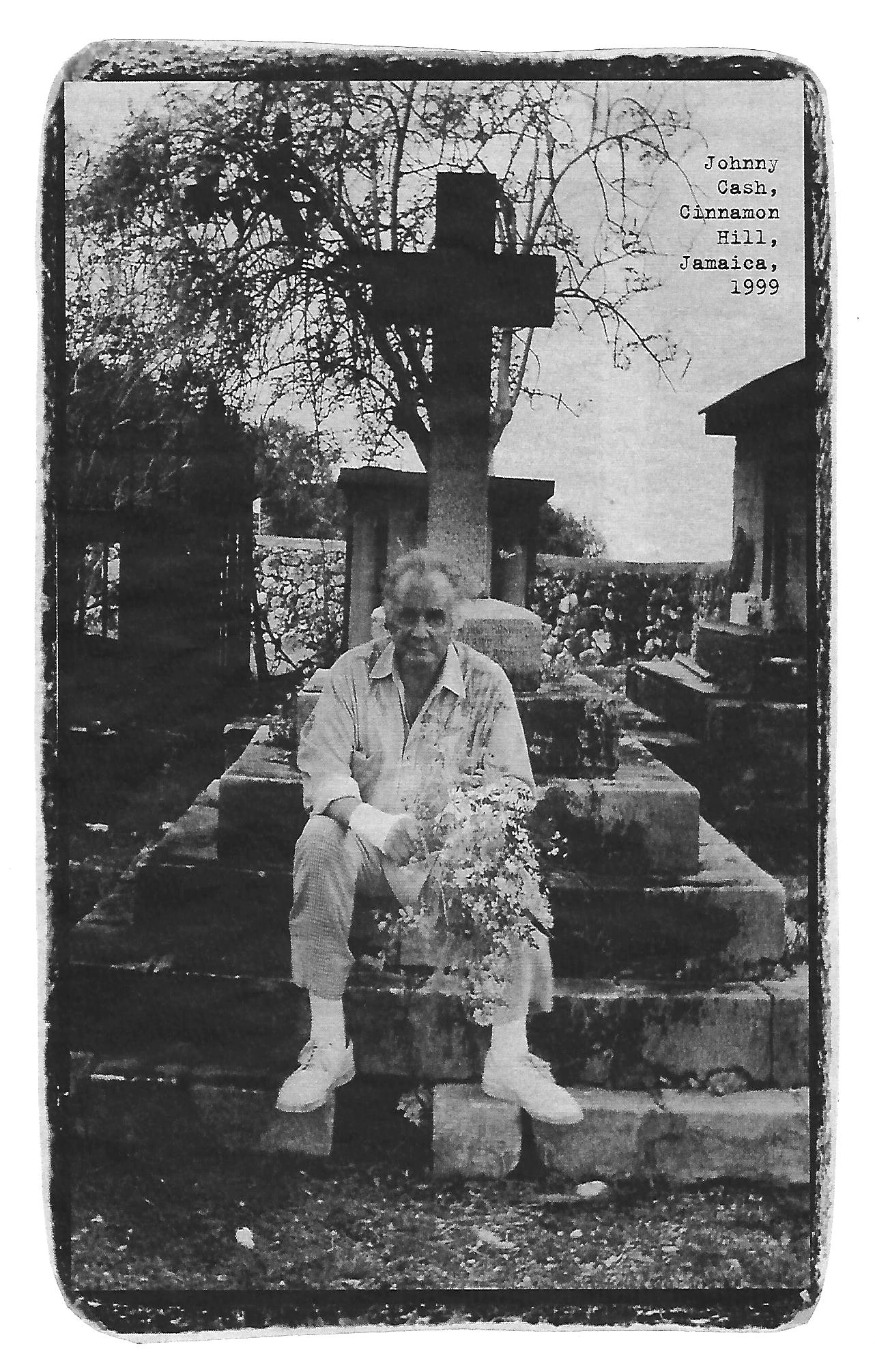
home – he has one outside Nashville and another in Jamaica and recording
music at his own pace. But performing live, unfortunately, has become a
thing of the past. “I haven’t take any offers for television, live
performances, commercials or any such thing for years,” Cash says. “So
long as we can keep the business going without al that, “I’m very
happy”. “I’ve had my 40-plus years on the stage.” Nonetheless, he
won’t rule out onscreen appearances. “I won’t say I will not do any
more Television,” he says. “Depends, a part in a movie? Depends. It
has to be exactly right in my mind before I’ll do it. No matter what,
music will always be his first priority. Johnny’s most recent album,
American #3 Solitary Man, was met with great commercial and critical
success and was recently nominated for the Academy Of Country Music’s
Best Album honor. “I guess that except for George Jones, I’m the
oldest country artist on the charts,” says Johnny. “That’s does make
me feel very good.” Solitary Man finds Johnny touching on some
subject’s dear to him, including the death penalty on the song Mercy
Seat. The track was recorded as Johnny’s home state of Tennessee staged
its first execution in 40 years. “The song does more than call attention
it the issue of the death penalty,” he says. “I won’t make stand
either way on it. I just wanted to call attention to some of the heartfelt
gut emotions that came along with it.”

Johnny says he hopes
“Mercy Seat” simply provokes listeners to think about the issue and
come to their own conclusions. “I wouldn’t be so presumptuous to say
that my can change the country,” he says. “Not at all. It’s about
touching emotions and reaching people’s hearts and guts. While Johnny
has been supportive of liberal causes in the past and has recorded
political charged songs such as “Man In Black,” he refuses to
explicitly support political candidates or parties. “I did that once a
few years ago, but I won’t do it anymore.” He says. I’ve been around
almost 50 years, and most of these politicians are there for four. “So I
don’t feel like it’s for me to say who I think the people should vote
for.” Instead, Johnny wants to focus his energy on his music. His record
label for the last eight years, American Recordings, remains very
enthusiastic about his music. “I have a standing order for one album
after another, unending,” he says. “Until I’m not able to record
anymore.” The singer becomes animated when talking about his next album,
which he promises will be musically heavier than his sparse recent albums.
“I really don’t care to be known as a folk singer,” he notes. “I
might use more instruments. There might be one or two with just my guitar,
but there are some things we’re finding that call for a little bigger
sound.
Cash
Back Guaranteed - Article May 5 - 11

The
Legendary Johnny Cash Talks About music, Old Times And Facing Down The
Future d

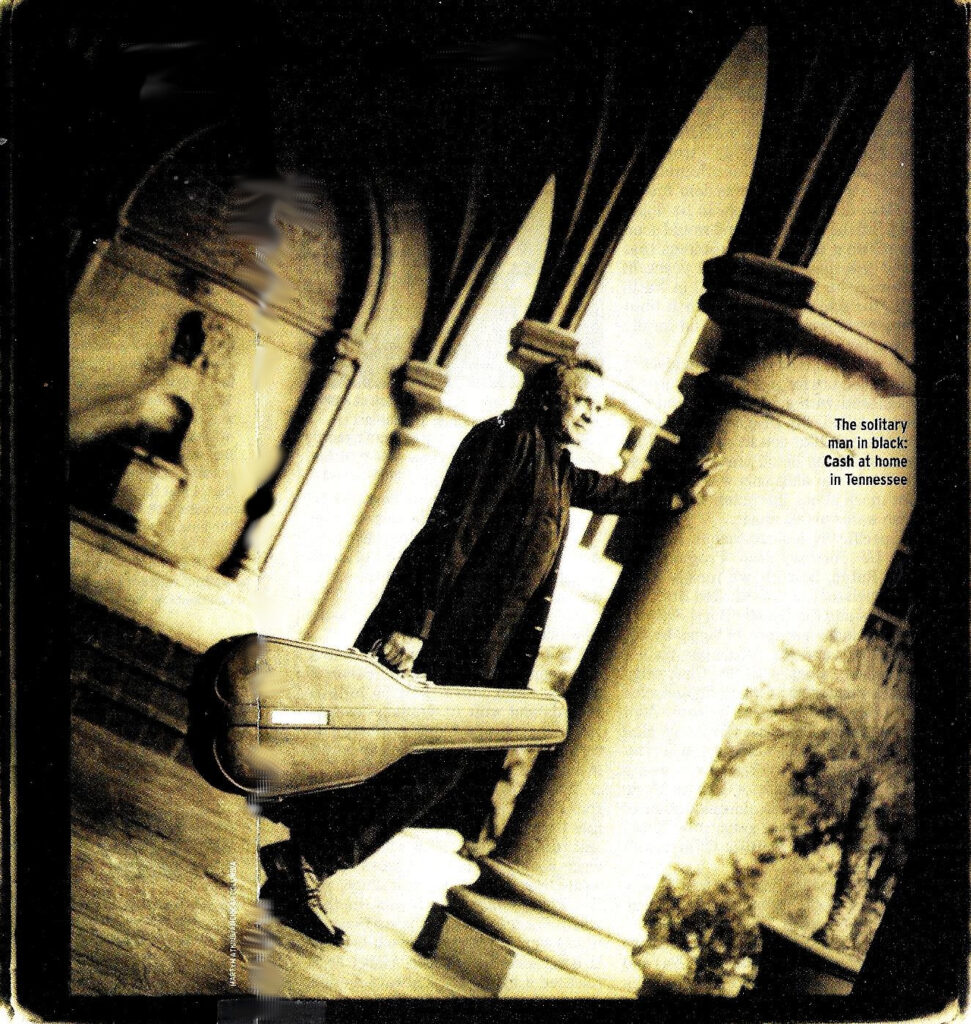
Johnny Cash may be the only
man in the world who looks right at home wearing a knee-length
cowboy-style duster in the bar of a posh midtown Manhattan hotel. It’s
an early October morning, and the 69-year old Cash has been enjoying the
city for several days, taking in a Broadway play, hosting dinners with is
wife, June Carter Cash, and visiting his record company. But for Cash,
whose storied career spanning nearly 50 years has eared him berth in the
country Rock And Roll, and Songwriters Halls Of Fame, even the ritziest
spots of Manhattan are accompanied by a Bob Dylan twang. I was telling
June last night I can’t go to New York and drive down the streets
without thinking of Bob “Cash says” Because the first time we spent
any time with him was in New York when he had his first two albums. And
I’m always singing his songs. With that, Cash launches into “Bob
Dylan’s Blues” “Well, The Lone Ranger and Tonto/They are riding down
the line/fixin everybody’s trouble ‘cept mine/somebody must’ve told
‘em/that/That I was doin fine.
Cash did, in fact, seem to
be doing fine. But the country legend would soon be battling health
problems that have bedeviled him in recent years. In February he was
hospitalized with in Nashville for pneumonia, his fourth bout with the
illness since 1998. And for the fourth time, he won the battle. Cash’s
health has been the subject of fan conjecture for years. In 1997, he was
diagnosed with a nervous-system disorder called Shy-Drager syndrome, a
Parkinson’s-like condition marked by wide swings in blood pressure. He
was later told the diagnosis was incorrect. But more about that later.
Right now, Cash wants to talk music. Specifically, his latest album,
American 111 Solitary Man. Produced by Rick Rubin, best known for his work
with such rock acts as the Red Hot Chili Peppers and the Beastie Boys,
Solitary Man includes versions of a songs by U2, Tom Petty and the
Australian rocker Nick Cave, along with five Cash original, a smattering
of standards and even a traditional folk ballad. Solitary Man proves once
again that Cash is a vital as anyone on today’s charts. It will compete
for album of the year at this week’s 36th Annual Academy of
Country Music Awards, putting Cash alongside some of Nashville’s
youngest guns; Toby Keith, Lee Ann Womack, Billy Gilman, and Brad Paisley.
“New branches on an old
tree” is how Cash describes the youngest writers he admires and records.
Cash two other albums for Rick Rubin’s American Recordings label,
American Recordings (1994) and Unchained (1996), featuring songs by Nick
Lowe, Beck and soundgarden. “I’d hear songs 10 years ago and say,
I’d never record anything like that. Well, it might be just what I what
I want today. I heard the U2 song, and I said, Man, what a great song. I
wish I could record something like that. And here finally come around to
recording it. I don’t think about age of the writer when I listen to a
song. That would really put some limitations on the possibilities of
songs. Cash know, I was one of the original rockabillies, but I felt for a
long time like I was around the fringes of rock and roll, he says. Elvis
asked me to write a song for him in, like 56 and I wrote Get Rhythm. I put
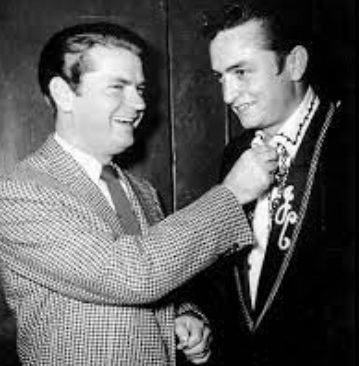
it down, and Sam Phillips (the owner of Sun Records) where Presley and
Cash began their careers wouldn’t let him have it because he’d sold
Elvis to RCA label. So He released it by me. But I always though that was
a kind of thing I could have gotten into much more in a big way back then
if I’d had the opportunity. But the blinders were being put on against
my well. Not that I don’t love country music; I do. But I was
categorized as countrified and I had been to town. Now it’s come a full
circle.

Cash has long taken a broad
view of America’s musical horizons. As Willie Nelson put it Kris
Kristofferson always refers to John as the father of our country. And
that’s good enough for me. Aside from doing as much as anyone to spur
country’s “outlaw” movement, Cash was instrumental in reminding
Nashville of the affinity between country and folk music, appearing at the
Newport Folk Festival in 1964. And when hosted his popular, self-titled
television variety show from 1969 to 1971, he made sure his quest were
drawn from virtually every facet of American popular music. Along with
Dylan, the show featured performances by Ray Charles, James Taylor, Joni
Mitchell, Stevie Wonder, Merle Haggard, Linda Ronstadt and Neil Young.
Still, Cash initially expressed surprise when he inducted to the Rock And
Roll Hall Of Fame in 1992. I’m not exactly the staple fare for MTV, he
says. Perhaps not, but today’s chroniclers of street life certainly owe
a big debt to the Man In Black. As the author of folsom Prison Blue, with
its infamous line “I shot A Man In Reno/Just To Watch Him Die” Cash
has strong opinion, regarding the debates about violence in music.
Let’s go back another
generation or two before “Folsom Prison Blues” he says Jimmie Rodgers
sang “I’m Gonna Buy Me A Shotgun As Long As I’m Tall/I’m Gonna
Shoot Poor Thelma/ Just To See Her Jump And Fall”. That’s one of the
classic lines in country music Songs of tragedy. You take the tragedy out
of country music – real country and folk music and you’ve got nothing.
Tragedy is a part of the lives of the pioneering and railroad people of
this country. Bridge builders, river workers, the brakemen on the railroad
who sang about a train about a train running over a man and cutting him to
pieces or a train wreck that killed everyone onboard. I have no apology
and no reservations to anybody about lyrics I wrote and recorded. If
lyrics are not reflection of society, then what are they worth? These
days, most of the recording for Cash’s albums is done in a studio behind
his home in Tennessee; He also has a winter home in Jamaica. He no longer
tours – We gave everything we had for 43 years, and enough is enough
already, he says – and prefers a more leisurely approach to making
albums: I don’t have to pack those damn black suitcases and black
clothes.
Conserving energy has been
essential for Cash in recent years. Since being diagnosed with Shy-Drager
syndrome he has spent most of the last few years receiving medical
treatment. Now however, he says he is feeling better and insists he was
misdiagnosed. I have no diagnosis now, he says. My doctor in Nashville
told me last year that she and the specialist for this disease decided I
don’t have it, or I’d be dead by now. She said, you’re getting
better all the time, and I said, that’s right I told you I don’t have
it, I deny it. That’s God in me, and that’s where he rises up and
where he’s at our beck and call. He healed me of that thing you people
tagged me with. And she said, Well, we’ll see. But I know where my bread
is buttered, and that’s with my faith in God. Someone said I looked
death in the eye, blinked a couple of times and just back up.
Acoustic
Guitar Article

In
the 50 years since Johnny Cash bought his first guitar, he’s sung gospel
songs and murder ballads, teen pop and country weepers, protest songs and
vaudeville novelties. It’s an output that’s unmatched in American
music, filled with a deep sense of respect for the past and an unsparing
honesty about the present.
After
starting life in 1932 as the son of an Arkansas sharecropper, he reached
mythic proportions as the Man in Black—what Cash calls "my symbol
of rebellion"—speaking out for the poor, the hopeless, and the
beaten down. Twenty-five years ago, Kris Kristofferson called him "a
walking contradiction, partly truth and partly fiction." But as the
years go by, those fictions keep dropping away, and the truth is all that
remains: Johnny Cash is the quintessential outsider, a stunning songwriter
and a frighteningly imperfect man, embracing the best and worst in this
country and in himself.
Now
69 years old, Cash is in the middle of his third comeback, resting after
last year’s Grammy-winning Solitary Man and getting ready for the
release of My Mother’s Hymn Book later this year. Refusing to
give in to the illness that’s struck his nervous system, he remains
expansive, hopeful, and indomitable, an artist still at the height of his
powers.
"I
couldn’t have asked for more," he says, talking from his home in
Montego Bay, Jamaica, where he and his wife June Carter Cash spend their
winters. "I looked at the country charts this morning, and except for
George Jones, I’m the oldest person there. And that makes me feel pretty
good. You know, maybe the numbers ain’t much, compared to a big rock
record, like Garth Brooks or Shania Twain. But I don’t care, I don’t
do that kind of stuff. What I do is what I feel like doing, and what I’m
proud of doing, from the time I do it until it’s past and gone."
Cash’s
earliest memories revolve around music. He remembers listening to his
mother Carrie singing spirituals in the cotton fields or sitting by the
woodstove while she strummed her Sears and Roebuck guitar, joining in on
the chorus of the Monroe Brothers’ "What Would You Give in Exchange
for Your Soul?"
"That’s
the first song I ever remember singing, when I was about four," he
says, his voice slowing to a crawl. "I was just in awe of that
guitar, that she could make music with her two hands on this piece of
wood. I told her that someday I wanted to have my own guitar, and she
said, ‘Maybe we can afford to keep this one.’ I didn’t realize it
then, but she was making payments on it, and at some point, when I was
five or six, all of a sudden, the guitar just wasn’t there. I remember
asking her, ‘Why don’t we sing and play the guitar anymore?’ She
just looked at me with tears in her eyes and said, ‘Son, we don’t have
a guitar.’"
When
they lost that guitar, Carrie Cash took in laundry to pay for John’s
three singing lessons, and when he was 12 years old, before he could play
a single note on guitar, he started writing songs. By then, a mail-order
radio had started to bring home the rest of the world—gospel from the
Chuck Wagon Gang, cowboy songs from Gene Autry, country music from the
Carter Family, Vernon Dalhart, and Jimmie Rodgers—and those were the
songs he wanted to write. He can’t remember much about those first
attempts at songwriting; he suspects his ex-wife may still have some of
the fragments. But he remembers that they were sad, slow ballads, the kind
of country weepers he calls "cry in your milk songs."
He
sang them on his walk to school and on the walk to see his friend Pete
Barnhill, who taught Cash his first guitar chords on a Gibson flattop.
"I thought he was the best guitar player in the world," says
Cash, a half century later. The first chance he got, Cash imitated
Barnhill’s guitar style, playing both rhythm and lead with his thumb and
occasionally brushing the strings with his fingers to accent the beat. As
far as he’s concerned, the technique was good enough for his mother and
good enough for Barnhill, so it’s been good enough for Cash ever since.
"I’m not a musician," he says. "I just accompany myself
on my guitar, just me and my thumb, no pick. I can only strum with my
thumb; I can’t pick it at all."
At
18, Cash graduated from high school and went to work on an automobile
assembly line in Pontiac, Michigan. That job didn’t last long, and after
a couple more—pouring concrete and cleaning out vats in a margarine
factory—he joined the Air Force. Stationed in Landsberg, Germany, Cash
spent the next three years intercepting Russian Morse code transmissions;
his voice still swells with pride when he talks about transcribing 35
words a minute. The Air Force gave Cash his first steady paycheck, $85 a
month, which he used to buy his first guitar.
"I
walked to town from the Air Force base, went to a music store, and bought
that guitar for five dollars," he says. "It was snowing when I
started walking back, and by the time I got to the base four miles away,
the snow was over knee-deep. I was freezing, I just had on these little
shoes, but somehow I managed to keep that guitar protected from the snow.
I got it back without being damaged, and immediately I started learning to
play, as soon as I could thaw out."
A
friend from Louisiana taught him a handful of chords, and after two or
three days of practice, Cash was able to sing and strum just about any
three-chord country song that came to mind. With two friends on the base,
a guitarist and a mandolinist, he formed the Barbarians, entertaining
rowdy local bars with songs like Hank Thompson’s "The Wild Side of
Life" and Joe Maphis’ "Dim Lights, Thick Smoke (And Loud, Loud
Music.)" Cash tore off the edge of a drink coaster and used it as a
pick. He damped the vibrations by sticking a piece of paper underneath his
strings, creating a short, percussive sound that felt like the Morse code
he listened to night after night.
It
was in Germany, away from his family for the first time in his life, that
Cash saw the movie Inside Folsom Prison and immediately identified
with the convicts. "It was like imprisonment," he says, talking
about his time in the Air Force. "I was locked there on that base,
three years without a furlough to come home. The only way they would have
let me come home was if there had been a death in my immediate family. I
was not only isolated from my loved ones, but there was nowhere to go, no
one to reach out to."
Cash
quit the Air Force after his second tour of duty and moved to Memphis,
Tennessee, where he married Vivian Liberto. Through his brother Roy, he
met guitarist Luther Perkins and bassist Marshall Grant. Together, they
found an occasional gig, played for free on Memphis radio, and, after a
year of knocking on doors, finally secured an audition with Sam Phillips
at Sun Records.
It
was Phillips who decided to call him Johnny, a name that Cash has never
liked. And it was Phillips who decided to record Cash as a rockabilly
artist, instead of as the gospel singer he’d claimed to be over the
telephone. They ran through a series of songs by Hank Snow, Jimmie
Rodgers, and the Carter Family before Phillips heard something he liked:
Cash’s "Hey Porter," which became the A side of his first
single. Three weeks and 35 takes later, they had the B side, too: Cash’s
"Cry Cry Cry," the response to Phillips’ instructions to write
"a real weeper."
The
single became a regional hit, earning Cash $6.42 in his first royalty
check and sending him on the road to open for Sonny James and Elvis
Presley. Over the next two years, Cash recorded a string of successes for
Sun, peaking with "I Walk the Line," which topped the country
charts for six weeks in 1956. There was a wide range of material, from
"Ballad of a Teenage Queen" to "Folsom Prison Blues"
to "Get Rhythm," but the formula was consistent: Perkins’
crudely effective Fender Telecaster; Grant’s spare, solid bass; and
Cash’s paper-dampened Martin D-28 keeping rhythm, rattling with that
snare drum boom-chicka beat.
"That
rhythm of the Morse code had a lot to do with the rhythm I felt in my
music," says Cash. "Every once in a while, I hear Morse code on
my shortwave radio, and I scribble it down. I can still copy it pretty
fast, and I wonder why that’s stuck with me for so long. I realized that
it’s got a rhythm that just begs to have a drum added to it, or a
guitar. After I got out of the Air Force, I could still hear it, and when
I started writing songs again, I had that rhythm in my head. And those
three years in Germany, where I thought I’d thrown away my personal
life—well, I like to feel that’s where I got it from."
After
those first hits, Cash left Sun for Columbia Records, where he stayed for
most of the next 30 years. It’s a period documented on last year’s
three-CD Love God Murder, a collection Cash says "took no time
at all" to compile. There was a lot of great music during these
years—gospel songs like "Were You There (When They Crucified My
Lord)," historic ballads like "The Legend of John Henry’s
Hammer," and pop hits like "Ring of Fire"—but when Cash
looks back, these are some of the recording sessions he wishes he had
"been a little more serious about, done a little better."
At
Columbia, Cash had the freedom to record concept albums about railroads,
Native Americans, blue-collar workers, and the life of Jesus Christ. These
were the years of his biggest hits and his busiest tour schedules. But as
his popularity grew, so did his drug use, until he was popping
amphetamines and barbiturates by the handful. His drug intake was
legendary, and so was his appetite for destruction; wherever he performed,
he left a trail of drunk tanks, car wrecks, and trashed hotel rooms. After
reaching the Grand Ole Opry, he smashed the footlights with his microphone
stand and was never asked back. In 1963 he hit rock bottom and left his
wife and three daughters to move to New York City.
Making
friends in Greenwich Village’s folk scene, Cash started taking new kinds
of drugs and getting into even more trouble. At his worst, he went for
days without sleeping, carrying a gun with him everywhere he went. At his
best, he sobered up long enough to record again, cultivating an outlaw
persona out of this downward spiral and releasing albums like Mean as
Hell. When people talk about the mythic Johnny Cash, this is the man
they remember: dark, violent, and unapologetic.
"Whether
we like it not, they’ve always been the most fascinating characters in
our history," says Cash of the antiheroes he sings about on Murder,
which has sold more copies than Love and God combined.
It’s a question he’s answered many times before, but even now, with
his voice growing weaker, he’s proud of all the nasty thugs he’s
written about. "Those are the songs I love to do," he says,
"ever since I started in this business."
On September 12, Willie Nelson will release his first .
|